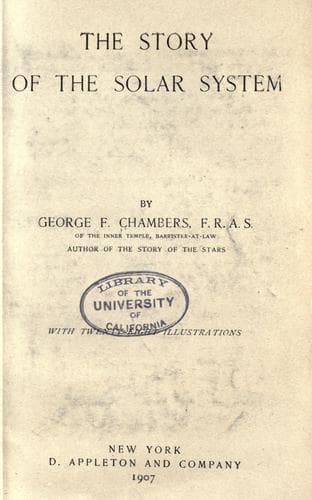
The Story of the Solar SystemChambers, George F. (George Frederick)
Science
The Story of the Solar System
Chambers, George F. (George Frederick)
Solar system
There is another class of Comet of which we see examples from time to
time, and having seen them once shall never see again. This is because
these Comets move in orbits which are not closed, and which are known as
parabolic or hyperbolic orbits respectively, because derived from those
sections of a cone which are called the Parabola and the Hyperbola. It
must be understood that what I am now referring to is purely a matter of
orbit, and that no relationship subsists between the size and physical
features of a Comet and the path it pursues in space. The only sort of
reservation, perhaps, to be made to this statement is, that the comets
celebrated for their size and brilliancy, are often found to be
revolving in elliptic orbits of great eccentricity, which means that
their periods may amount to many centuries.
It may be well to say something now as to what is the ordinary career of
a comet, so far as visibility to us, the inhabitants of the Earth, is
concerned. Though this might be illustrated by reference to the history
of many comets, perhaps there is no one more suitable for the purpose
than Donati’s Comet of 1858. In former times, when telescopes were few
or non-existent, brilliant comets often appeared very suddenly, just as
a carriage or a man does, as you turn the corner of a street. Such
things even happen still: for instance, the great comet of 1861 burst
upon us all at once at a day’s notice. Usually, however, now in
consequence of the large size of the telescopes in use, and the great
number of observers who are incessantly on the watch, comets are
discovered when they are very small, because remote both from the Earth
and Sun, and many weeks, or even months, it may be, before they shine
forth in their ultimate splendour. Now, let us see how these statements
are supported by the history of Donati’s comet in 1858. On June 2 in
that year, it was first seen by Donati at Florence, as a faint
nebulosity, slowly journeying northwards. June passed away, and July,
and August, the comet all the while remaining invisible to the naked
eye; that is to say, it first became perceptible to the naked eye on
August 29, having put forth a faint tail about August 20. After the
beginning of September its brilliancy rapidly increased. On September
17, the head equalled in brightness a 2nd magnitude star, the tail being
4° long. Passing its point of nearest approach to the Sun on September
29, it came nearest to the Earth on October 10; though, perhaps, its
appearance a few days previously, namely on October 5, is the thing best
remembered by those who saw it, because it was on that night that the
comet passed over the 1st magnitude star Arcturus. For several days
about this time, the comet was an object of striking beauty in the
Western Heavens, during the hours immediately after sun-set. After
October 10, it rapidly passed away to the Southern hemisphere,
diminishing in brightness, as it did so, because receding from the Earth
and the Sun.
Public-domain text, read in full here on John Shaqi.
Reviews
Reviews
No reviews yet
Be the first to share your thoughts on this work.
Elsewhere in the archive
Join the Discussion
Join the discussion
Sign in to leave a comment or review.
Sign InorCreate an account