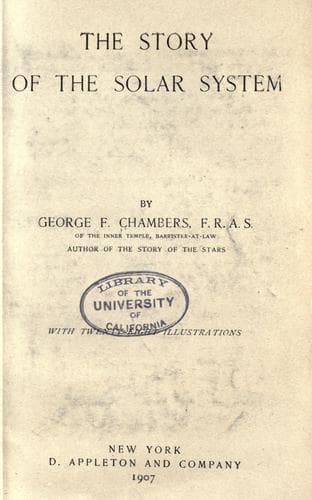
The Story of the Solar SystemChambers, George F. (George Frederick)
Science
The Story of the Solar System
Chambers, George F. (George Frederick)
Solar system
It seems impossible to doubt that some tails of comets are hollow
cylinders or hollow cones. Such a theory would account for the fact, so
often noticed, that single tails are usually much brighter at their two
edges than at the centre. This is the natural effect of looking
transversely at any translucent cylinder of measureable thickness.
It was long a moot point whether comets are self-luminous, or whether
they shine by reflected light; but it is now generally admitted that
whilst a part of the light of a comet may be derived by reflection from
the Sun yet as a rule they must be regarded as shining by their own
intrinsic light.
It should be stated here by way of caution that the observations on this
subject are not so consistent as one could wish, and it seems necessary
to assume that all comets are not constituted alike, and that therefore
what is true of one does not necessarily apply to another.
To those who possess telescopes (not necessarily large ones)
opportunities for the study of comets have much multiplied during the
last few years, for we are now acquainted with a group of small comets
which are constantly coming into view at short intervals of time. The
comets have now become so numerous that seldom a year passes without one
or more of them coming into view. Whilst that known as Encke’s revolves
round the Sun in 3¼ years, Tuttle’s doing the same in 13½ years, there
are four others whose periods average about 5½ years, 5 which average 6½
years, together with one of 7½ years and one of 8 years. It is thus
evident that there is a constant succession of these objects available
for study, and that very few months can ever elapse that some one or
more of them are not on view. They bear the names of the astronomers who
either discovered them originally, or who, by studying their orbits,
discovered their periodicity. The names run as follows, beginning with
the shortest in period and ending with the longest:—
Encke’s. Winnecke’s.
Temple’s Second (1873, II.) Brorsen’s.
Temple’s First (1867, II.)
Swift’s (1880, V.) Wolf’s (1884, III.)
Barnard’s (1884, II.) Faye’s.
D’Arrest’s. Denning’s.
Finlay’s. Tuttle’s.
I cannot stay to dwell upon either the history or description of these
comets separately, but must content myself by saying generally that
whilst as a rule they are not visible to the naked eye, yet several of
them may occasionally become so visible when they return to perihelion
under circumstances which bring them more near than usual to the earth.
Several other comets are on record which it was supposed at one time
would certainly have been entitled to a place in the above list, but
three of them in particular have, under very mysterious circumstances,
entirely disappeared from the Heavens.
Public-domain text, read in full here on John Shaqi.
Reviews
Reviews
No reviews yet
Be the first to share your thoughts on this work.
Elsewhere in the archive
Join the Discussion
Join the discussion
Sign in to leave a comment or review.
Sign InorCreate an account