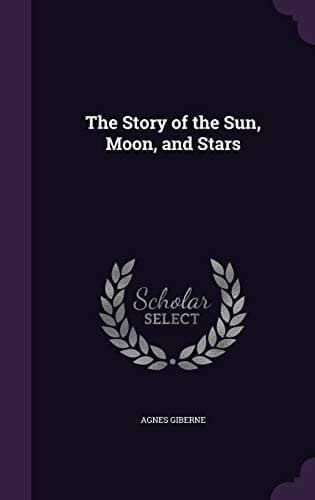
The story of the sun, moon, and starsGiberne, Agnes
Science
The story of the sun, moon, and stars
Giberne, Agnes
Astronomy -- Juvenile literature
“One evening, when I was contemplating, as usual, the celestial
vault, whose aspect was so familiar to me, I saw, with inexpressible
astonishment, near the zenith, in Cassiopeia, a radiant star of
extraordinary magnitude. Struck with surprise, I could hardly believe
my eyes. To convince myself that it was not an illusion, and to obtain
the testimony of other persons, I called out the workmen employed in my
laboratory, and asked them, as well as all passers-by, if they could
see, as I did, the star, which had appeared all at once. I learned
later on that in Germany carriers and other people had anticipated the
astronomers in regard to a great apparition in the sky, which gave
occasion to renew the usual railleries against men of science (as with
comets whose coming had not been predicted).
“The new star was destitute of a tail; no nebulosity surrounded it;
it resembled in every way other stars of the first magnitude. Its
brightness exceeded that of Sirius, of Lyra, and of Jupiter. It could
only be compared with that of Venus when it is at its nearest possible
to the earth. Persons gifted with good sight could distinguish this
star in daylight, even at noonday, when the sky was clear. At night,
with a cloudy sky, when other stars were veiled, the new star often
remained visible through tolerably thick clouds. The distance of
this star from the other stars of Cassiopeia, which I measured the
following year with the greatest care, has convinced me of its complete
immobility. From the month of December, 1572, its brightness began to
diminish; it was then equal to Jupiter. In January, 1573, it became
less brilliant than Jupiter; in February and March, equal to stars of
the first order; in April and May, of the brightness of stars of the
second order. The passage from the fifth to the sixth magnitude took
place between December, 1573, and February, 1574. The following month
the new star disappeared without leaving a trace visible to the naked
eye, having shone for seventeen months.”
These circumstantial details permit us to imagine the influence
which such a phenomenon must have exercised on the minds of men. Few
historical events have caused so much excitement as this mysterious
envoy of the sky. It first appeared on November 11, 1572. General
uneasiness, popular superstition, the fear of comets, the dread of the
end of the world, long since announced by the astrologers, were an
excellent setting for such an apparition. It was soon announced that
the new star was the same which had led the wise men to Bethlehem,
and that its arrival foretold the return of the Messiah and the last
judgment. For the hundredth time, perhaps, this sort of prognostication
was recognized as absurd. It did not, however, prevent the astrologers
from being believed, twelve years later, when they announced anew the
end of the world for the year 1588; these predictions exercised the
same influence on the public mind.
Public-domain text, read in full here on John Shaqi.
Reviews
Reviews
No reviews yet
Be the first to share your thoughts on this work.
Elsewhere in the archive
Join the Discussion
Join the discussion
Sign in to leave a comment or review.
Sign InorCreate an account