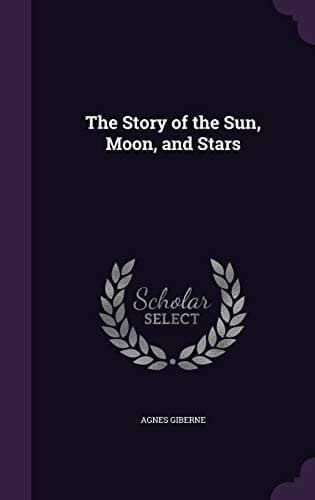
The story of the sun, moon, and starsGiberne, Agnes
Science
The story of the sun, moon, and stars
Giberne, Agnes
Astronomy -- Juvenile literature
It is easy to photograph the sun, and this has been done. When we come
to the moon the operation is more difficult on account of the feeble
intensity of its light, and the difference of tint of the various parts
of its surface. Skill and perseverance have, however, surmounted the
greatest difficulties, and now we have photographs of the moon enlarged
to more than a yard in diameter, which show the smallest details with a
truly admirable clearness.
In the first second of time, your eye receives as much light from the
star as does the photographic plate in the same time. But during the
course of one hour, the plate receives and stores up about thirty-six
hundred times as much light as it or you received in the first instant.
There is the secret of the matter. The photographic plate does not only
receive, it can also keep and treasure up the light, and that our eyes
are not able to do.
If you magnify the amount received in one hour by five or ten, and
remember that it is all retained, then you will begin to understand
how feeble stars, unseen by man, should become known to us through
photography.
CHAPTER XXXII.
THE DAWN OF ASTRONOMY.
The beginnings of astronomy lie in the distance of earliest historical
ages. It is no easy matter to say when first, in all probability, this
science grew into existence. Astronomy was alive before the British
nation was heard of; before Saxons or Franks had sprung into being;
before the Roman Empire extended its iron rule; before the Grecian
Empire began to flourish; before the Persian Empire gained power;
before the yet earlier Assyrian Empire held sway.
Among the ancient Chaldeans were devoted star-gazers--much more devoted
than the ordinary run of educated Anglo-Saxons in this present century.
They earnestly sought, in the dim light of those ages, to decipher the
meaning of heaven’s countless lamps. We have better instruments, and
more practiced modes of reasoning; also, we have the collected piles
of knowledge built up by our forefathers through tens of centuries.
Yet our search is in essence the same as was theirs, to know the truth
about the stars: not merely to start some attractive theory, and then
to prove that our theory must be right, because we have been so clever
as to start it; but to discover that which is in those regions of
space. No lower aim than this is worthy to be called scientific.
Public-domain text, read in full here on John Shaqi.
Reviews
Reviews
No reviews yet
Be the first to share your thoughts on this work.
Elsewhere in the archive
Join the Discussion
Join the discussion
Sign in to leave a comment or review.
Sign InorCreate an account