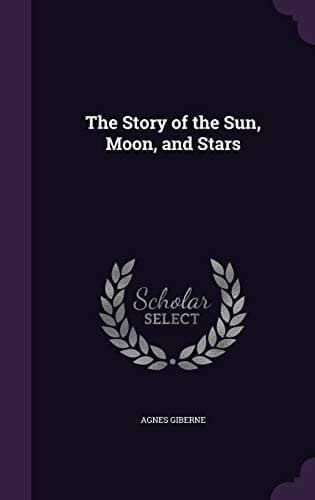
The story of the sun, moon, and starsGiberne, Agnes
Science
The story of the sun, moon, and stars
Giberne, Agnes
Astronomy -- Juvenile literature
But an essential difference existed between the infantine science of
those primitive days and the matured astronomy of these later days.
The whole ancient science was built upon a huge mistake. Men held,
as a fact of absolutely unquestionable certainty, that this earth
of ours--this small whirling globe, less than eight thousand miles
in diameter--was the center, around which sun, moon, and stars all
revolved.
The Greek philosopher Thales, who lived about six hundred years before
Christ, is said to have laid the foundations of the Grecian astronomy;
and Pythagoras is stated to have been one of his disciples. Though, in
many respects, Thales wandered wide of the truth, he yet taught many
correct ideas; as, for instance, that the stars were made of fire; that
the moon had all her light from the sun; that the earth was a sphere
in shape, besides other facts respecting the earth’s zones and the
sun’s apparent path in the sky. He was also one of the three ancient
astronomers who were able to calculate and foretell eclipses.
After him came numerous astronomers, of greater or less merit, in the
Grecian and in other schools. They watched carefully; they discovered
many things of interest; they held divers theories. But one truth never
took firm root among them, although several of them dimly apprehended
it; and this was the very foundation-truth, for lack of which they were
all going hopelessly astray--the simple truth that our earth is _not_
the center of the universe, and that our earth _does_ move. Yet it is
not surprising. No wonder they were slow to grasp such a possibility.
Anything more bewildering to the mind of ancient man than the thought
of a solid, substantial world floating in empty space, supported upon
nothing, upheld by nothing, can hardly be imagined. As yet little was
known of the controlling laws or forces of nature, and that little was
with reference only to our earth. The very suspicion of gravitation
as a universal law lay in the far-distant future, waiting for the
intellect of a Newton to call it out of apparent chaos; and the
delicate balance of forces, by means of which the Solar System may
almost be said to exist, could not be so much as guessed at.
So men still clung to the thought of earth as the center of all things,
and still believed in a little sun, busily circling round her once in
every twenty-four hours.
Perhaps the greatest of all ancient astronomers was Hipparchus, about
150 B. C., who did more than any other in those early times to gather
together the scattered facts of astronomy, and to arrange them into
one united and orderly whole. He it was who discovered the precession
of the equinoxes. He studied eclipses and the motions of the various
planets. He made elaborate and valuable astronomical tables and
star-catalogues; but he, like others, failed to discover the gigantic
error which lay at the root of the whole ancient science.
Public-domain text, read in full here on John Shaqi.
Reviews
Reviews
No reviews yet
Be the first to share your thoughts on this work.
Elsewhere in the archive
Join the Discussion
Join the discussion
Sign in to leave a comment or review.
Sign InorCreate an account