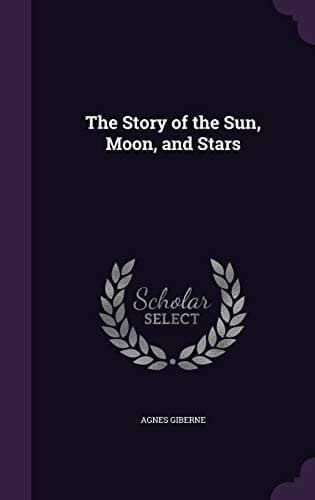
The story of the sun, moon, and starsGiberne, Agnes
Science
The story of the sun, moon, and stars
Giberne, Agnes
Astronomy -- Juvenile literature
It was the 5th of June, 1660, when Isaac Newton, a youth of eighteen,
was enrolled as an undergraduate of Trinity College, Cambridge. Little
did those who sent him there dream that this boy was destined to be the
most illustrious student who ever entered the portals of that great
seat of learning. Little could the youth himself have foreseen that the
rooms near the gateway which he occupied would acquire a celebrity from
the fact that he dwelt in them, or that the antechapel of his college
was in good time to be adorned by that noble statue of himself which
is regarded as the chief art treasure of Cambridge University, both
on account of its intrinsic beauty and the fact that it commemorates
the fame of her most distinguished alumnus, Isaac Newton, the immortal
astronomer. His advent at the university seemed to have been by
no means auspicious or brilliant. His birth was, as we have seen,
comparatively obscure, and though he had already given indication of
his capacity for reflecting on philosophical matters, yet he seems to
have been but ill-equipped with the routine knowledge which youths are
generally expected to take with them to the universities.
From the outset of his college career, Newton’s attention seems to have
been mainly directed to mathematics. Here he began to give evidence of
that marvelous insight into the deep secrets of nature which, more than
a century later, led so dispassionate a judge as Laplace to pronounce
Newton’s immortal work as pre-eminent above all the productions of
the human intellect. But though Newton was one of the very greatest
mathematicians that ever lived, he was never a mathematician for the
mere sake of mathematics. He employed his mathematics as an instrument
for discovering the laws of nature.
His industry and genius soon brought him under the notice of the
university authorities. It is stated in the university records that
he obtained a scholarship in 1664. Two years later we find that
Newton, as well as many residents in the university, had to leave
Cambridge temporarily on account of the breaking out of the plague. The
philosopher retired for a season to his old home at Woolsthorpe, and
there he remained until he was appointed a Fellow of Trinity College,
Cambridge, in 1667. From this time onwards, Newton’s reputation as a
mathematician and as a natural philosopher steadily advanced, so that
in 1669, while still but twenty-seven years of age, he was appointed to
the distinguished position of professor of Mathematics at Cambridge.
Here he found the opportunity to continue and develop that marvelous
career of discovery which formed his life’s work.
Public-domain text, read in full here on John Shaqi.
Reviews
Reviews
No reviews yet
Be the first to share your thoughts on this work.
Elsewhere in the archive
Join the Discussion
Join the discussion
Sign in to leave a comment or review.
Sign InorCreate an account