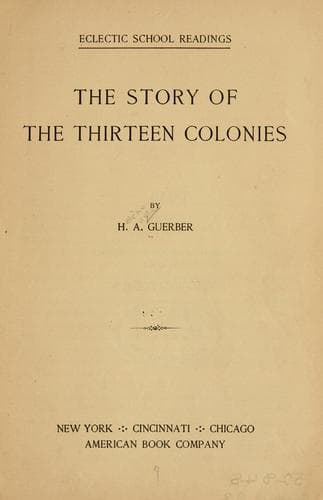
The Story of the Thirteen ColoniesGuerber, H. A. (Hélène Adeline)
History
The Story of the Thirteen Colonies
Guerber, H. A. (Hélène Adeline)
United States -- History -- Colonial period, ca. 1600-1775
In this battle, which is called the "battle of Bunker Hill," the
British drove the patriots away, but at the cost of so many lives
that when the news reached Europe a French statesman said: "Two more
such victories, and England will have no army left in America."
Not only did many British soldiers perish, but as the Americans
discovered that the only cause of their defeat on this occasion was
lack of ammunition, they looked forward to the next battle without
fear.
All felt, as Ward said, that "We shall finally come off victorious,
and triumph over the enemies of freedom and America." This belief,
however, was not shared in England, although Franklin proved that
it had cost the mother country three million pounds and many men to
kill about three hundred and fifty Yankees. He added that in the
meantime so many children had been born in our country that, at that
rate, it would be impossible to find men and money enough to conquer
the whole territory.
LXIV. THE BOSTON BOYS.
The news of the battle of Bunker Hill, and of Howe's setting fire to
Charlestown during the struggle, was sent without delay to Congress.
The messenger who bore it met Washington on his way to Cambridge to
take command of the army. The general in chief eagerly asked how the
Americans had behaved, and when he heard that they had stood their
ground bravely, he fervently cried: "The liberties of the country
are safe!"
[Illustration: The Cambridge Elm.]
The messenger then continued on his way, and when the news reached
Congress there was great excitement. The patriots felt that the
fight could now end only when their rights were assured; and
Franklin wrote to some friends in England: "England has lost her
colonies forever."
Riding on, Washington quickly reached Cambridge, where he made his
headquarters in the house later occupied by the famous American
poet Longfellow. In the beginning of July, 1775, standing under the
Cambridge Elm, Washington took command of the continental army,
composed of about fifteen thousand men of every age and size. They
were armed with hunting rifles, knives, swords, or pitchforks; most
of them had no idea of military drill or discipline, and all were in
need of arms, ammunition, uniforms, and food.
It was impossible to fight without three of these things; so
while the patriots brought food for the soldiers, Washington
bestirred himself to secure arms and ammunition, begging Congress
to supply hunting shirts, so that his army might present a more
orderly appearance. To prevent the enemy from discovering, through
spies, that he had less than half a pound of powder for each man,
Washington had a number of barrels filled with sand. A little powder
was put on top of each, and they were stored away and guarded as
carefully as if there were the greatest danger of their exploding at
any minute.
Public-domain text, read in full here on John Shaqi.
Reviews
Reviews
No reviews yet
Be the first to share your thoughts on this work.
Elsewhere in the archive
Join the Discussion
Join the discussion
Sign in to leave a comment or review.
Sign InorCreate an account