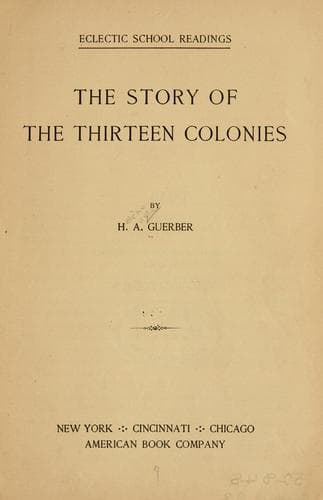
The Story of the Thirteen ColoniesGuerber, H. A. (Hélène Adeline)
History
The Story of the Thirteen Colonies
Guerber, H. A. (Hélène Adeline)
United States -- History -- Colonial period, ca. 1600-1775
But Washington did not linger there long. Suspecting that Howe's
next attempt would be to seize New York, and fearing lest he might
have gone there straight from Boston, Washington soon hurried away.
Just before he left the city, a British ship, laden with powder,
sailed into the harbor, as its captain thought the British were
still there. Its cargo was quickly seized, and provided the American
army with seven times more powder than they had been able to secure
by any other means.
About three months later a second British fleet, under Clinton,
suddenly appeared off Charleston, where it began bombarding Fort
Moultrie (moo´trī). The governor of Charleston having sent word to
the general, "Keep cool and do mischief," the fire was promptly
returned. Besides, the British were greatly dismayed to see their
cannon balls burying themselves harmlessly in the soft palmetto logs
and the big sand heaps of which the fort was composed. But the balls
from the fort crippled the British vessels so badly that they had to
sail away again without taking possession of Charleston.
In the midst of this battle, a British cannon ball cut Fort
Moultrie's flagstaff in two, and brought down the flag. The enemy
cheered loudly at this lucky shot; but a sergeant named Jasper
quickly jumped over the parapet, caught up the fallen flag, and set
it up again, notwithstanding the hail of bullets falling around him;
so that it was now the Americans' turn to raise a cheer of triumph.
In reward for his daring action, Jasper was offered the rank of
lieutenant; but as he could neither read nor write, he sadly refused
it, saying: "I am not fit for the company of officers."
LXVI. DECLARATION OF INDEPENDENCE.
In June, 1776, Richard Henry Lee brought into Congress a resolution
"that these United Colonies are, and of right ought to be, free
and independent States." This was now the opinion of the principal
men in our country, and Washington wrote: "When I took command of
the army, I abhorred the idea of independence; now I am convinced
nothing else will save us."
[Illustration:
_John Trumbull, Artist._
Signing the Declaration of Independence.]
The minds of the people having been prepared for the change by a
little pamphlet called "Common Sense," Congress appointed five men
to draw up a Declaration of Independence. These five men were Thomas
Jef´fer-son, Benjamin Franklin, John Adams, Roger Sherman, and
Robert Liv´ing-ston; but as the paper, with the exception of a few
words, is the work of Jefferson, he is generally called the "Father
of the Declaration of Independence."
[Illustration: Jefferson's Writing Desk.]
Public-domain text, read in full here on John Shaqi.
Reviews
Reviews
No reviews yet
Be the first to share your thoughts on this work.
Elsewhere in the archive
Join the Discussion
Join the discussion
Sign in to leave a comment or review.
Sign InorCreate an account