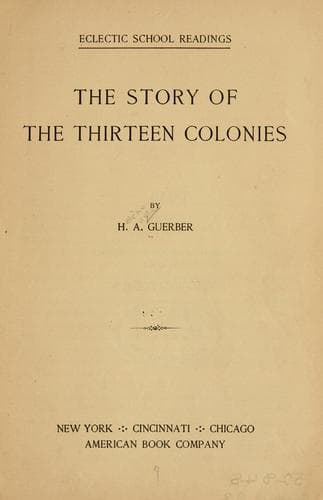
The Story of the Thirteen ColoniesGuerber, H. A. (Hélène Adeline)
History
The Story of the Thirteen Colonies
Guerber, H. A. (Hélène Adeline)
United States -- History -- Colonial period, ca. 1600-1775
Besides the American patriots, foreigners were helping Washington
with all their might. Among these was the Prussian officer, Baron
Steuben, who knew no English, and therefore brought over an
interpreter with him. According to one story, this interpreter
made an idle bet to kiss the first Yankee girl he met. Landing at
Portsmouth, this man won his wager by stepping up to a pretty girl,
bowing politely, and begging permission to kiss her, saying: "Before
leaving my native land to fight for American freedom, I made a vow
to ask, in earnest of victory, a kiss from the first lady I should
meet." The story adds that the young lady accepted the kiss, saying
she could not refuse so small a favor to a man who had come to
fight, and if necessary, to die, for her country.
Steuben joined Washington at Valley Forge, and there began to drill
the troops, so they could meet the British on an equal footing. At
first the German officer was shocked by their lack of discipline,
and swore at them in every language he knew; sometimes he even
called to his interpreter: "Come and swear for me in English; these
fellows will not do what I bid them."
You see, soldiers in those days thought it manly to swear; and as
Baron Steuben had been accustomed to European soldiers, who obeyed
without a question, it took him some time to grow used to Americans,
who, as he said, had to be told, "This is the reason why you ought
to do that," before they would obey. Still, he soon taught our men
to fight like old and trained soldiers.
The winter the troops spent at Valley Forge was one of the coldest
ever seen, and therefore the soldiers' sufferings were very great.
But with the spring, hope revived, for the news of the coming French
fleet made the British leave Philadelphia to defend New York.
General Howe having gone back to England for his health, it was
Clinton who conducted this retreat. Leaving the camp at Valley
Forge, Washington pursued him across New Jersey, planning to engage
him in a battle at Mon´moŭth (1778).
Here Lee, who had been exchanged for Prescott, and was again in
command, disobeyed orders, and bade his men retreat. Warned by
Lafayette, Washington came up just in time to check this movement,
and, dashing up to Lee, hotly asked what his disobedience meant.
Lee answered: "These men cannot face the British grenadiers." But
Washington exclaimed: "They can do it, and they shall!" He was
right; the men could, and did, face the enemy bravely. But precious
time had been lost, and instead of winning a victory, the Americans
only managed to stand their ground.
[Illustration: Molly Pitcher.]
During the battle, Molly Pitcher, a gunner's wife, carrying a pail
of water to her husband, saw him fall. She immediately rushed
forward, took his place, and, loading his cannon, fired it as
quickly and well as he. In reward for filling her husband's place
that day, Congress paid her a small pension, and the soldiers, who
admired her pluck, ever after called her "Major Molly."
Public-domain text, read in full here on John Shaqi.
Reviews
Reviews
No reviews yet
Be the first to share your thoughts on this work.
Elsewhere in the archive
Join the Discussion
Join the discussion
Sign in to leave a comment or review.
Sign InorCreate an account