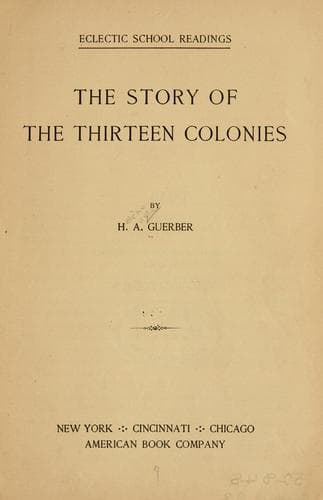
The Story of the Thirteen ColoniesGuerber, H. A. (Hélène Adeline)
History
The Story of the Thirteen Colonies
Guerber, H. A. (Hélène Adeline)
United States -- History -- Colonial period, ca. 1600-1775
The officer, hearing this, suggested that the Americans probably
gave their soldiers big pay to make up for such poor fare and
uncomfortable quarters. But Marion truthfully answered that he
received no salary at all. The astonished officer then asked why he
served such a mean country at all; and the brave young Southerner,
looking him full in the face, proudly remarked that a man was always
ready to do anything for the lady he loved, and that the name of his
sweetheart was Liberty.
The British officer could not but admire such a man and such an
answer. On returning to camp, we are told, he left the service,
saying he would have no share in depriving such brave men as Marion
of the rights due them.
LXXVIII. THE POOR SOLDIERS.
In the meantime things were going very badly in the North. The
winter spent at Valley Forge had, indeed, been hard to bear, but
that which Washington spent at Morristown was in some respects even
worse. Congress, in those days, had no power to tax the people to
raise money, the states were in many cases too poor to supply much,
and it was very difficult to borrow funds abroad, because it was
quite evident that if the Americans were beaten their debts would
never be paid.
Already in 1777 Congress began to issue paper money. Of course it
had no real value of its own, like gold or silver, but was merely a
promise that Congress would some day give the bearer the amount it
called for in real money. As everybody knew that Congress did not
have, and therefore could not give, gold or silver in exchange for
these "continental bills," no one liked to take them in payment for
food or clothing.
To make matters worse, the British printed ever so many bills just
like those issued by Congress, and paper money soon became so nearly
worthless as to give rise to the expression still used, "Not worth
a continental." By this time there was two hundred millions' worth
of this money in circulation, and people gave one hundred and fifty
dollars in bills for a bushel of corn, and several thousand for a
suit of clothes, when they had no silver or gold.
Many times during the Revolutionary War the soldiers, knowing their
families were starving, clamored loudly for their money. As it was
not paid to them, some of them rebelled, and it took all their love
for Washington--the only person whom they really trusted--to hold
the army together. Still, these soldiers were faithful to their
country; for when British spies once came among them, offering gold
if they would only desert, they nobly gave these spies up to their
officers, saying that, while they wanted their dues, they were not
traitors.
The British not only tried to win over the men, but also attempted
to bribe American officers and statesmen. But they failed in this,
too; and when they approached Joseph Reed, he proudly said: "I am
not worth purchasing; but such as I am, the King of Great Britain is
not rich enough to buy me."
Public-domain text, read in full here on John Shaqi.
Reviews
Reviews
No reviews yet
Be the first to share your thoughts on this work.
Elsewhere in the archive
Join the Discussion
Join the discussion
Sign in to leave a comment or review.
Sign InorCreate an account