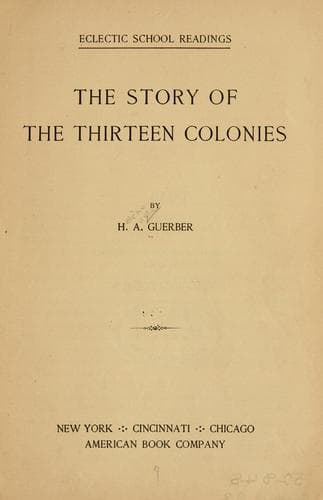
The Story of the Thirteen ColoniesGuerber, H. A. (Hélène Adeline)
History
The Story of the Thirteen Colonies
Guerber, H. A. (Hélène Adeline)
United States -- History -- Colonial period, ca. 1600-1775
After the battle of Guilford Courthouse, Cornwallis retreated to
the coast, and Greene turned his attention to the British forces
farther south, with which he fought the battles of Hobkirk Hill and
Eu´taw Springs. In the latter engagement, Marion, surrounded by
the foe, encouraged his brave men by saying: "Hold up your heads,
boys! Three fires, three cheers, and a charge, and you are free!"
During the same engagement one of Lee's men found himself alone and
without arms in the midst of the enemy. With great presence of mind,
he seized an officer, wrenched his sword out of his hand, and, using
him as a shield, fought his way back to his friends.
Though Greene was often defeated and never won a great victory, the
British loudly complained that he never knew when he was beaten.
But while Greene modestly described his own doings as, "We fight,
get beat, rise and fight again," he and his two thousand men were
little by little driving the British out of South Carolina. Indeed,
by their brave efforts the Americans finally recovered both South
Carolina and Georgia, with the exception of the cities of Charleston
and Savannah.
LXXXII. THE SURRENDER OF CORNWALLIS.
Retreating from the Carolinas, Cornwallis marched into Virginia
to take the place of Arnold, whom the British had been watching
closely, lest he should betray them, too. Clinton now bade
Cornwallis keep near the coast, so that he could embark quickly and
come to the rescue of New York, in case Washington should suddenly
attack it.
The fact was, though, that Washington had no intention of doing
anything of the sort. On the contrary, he had laid his plans to
catch Cornwallis in Virginia, where he had sent Lafayette some time
before. As he did not wish Clinton to suspect this plan, Washington
wrote letters saying he meant to take New York, and cleverly
contrived that they should accidentally fall into British hands.
After reading them, Clinton felt so sure he knew all about the
American plans that he did not stir.
There was no telegraph in those days, and it was a great surprise to
Cornwallis when the French fleet, under De Grasse (grahss) suddenly
appeared in Chesapeake Bay. Thus, even before Clinton suspected the
Americans' intentions, Cornwallis was hemmed in at Yorktown between
Lafayette's troops and De Grasse's fleet, and Washington was rapidly
marching southward to help them.
Hoping to check Washington's advance, or even force him to come
back, Clinton now sent Arnold into Connecticut, where, as we have
seen, he burned New London. This base deed so angered a lady whose
guest he had once been, that she tried to shoot him, we are told,
and would have done so, had not her gun missed fire.
Public-domain text, read in full here on John Shaqi.
Reviews
Reviews
No reviews yet
Be the first to share your thoughts on this work.
Elsewhere in the archive
Join the Discussion
Join the discussion
Sign in to leave a comment or review.
Sign InorCreate an account