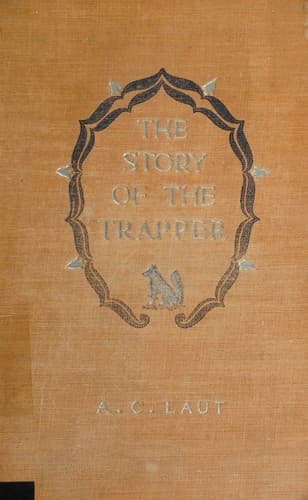
Fur trade -- North America; Northwest, Canadian -- History; Northwestern States -- History; Trapping
When the birds have gone south the silence of a winter forest on a
windless day becomes tense enough to be snapped by either a man's
breathing or the breaking of a small twig; and the trapper acquires a
habit of moving through the brush with noiseless stealth. He must learn
to see better than the caribou can hear or the wolf smell--which means
that in keenness and accuracy his sight outdistances the average
field-glass. Besides, the trapper has learned how to look, how to see,
and seeing--discern; which the average man cannot do even through a
field-glass. Then animals have a trick of deceiving the enemy into
mistaking them for inanimate things by suddenly standing stock-still in
closest peril, unflinching as stone; and to match himself against them
the trapper must also get the knack of instantaneously becoming a
statue, though he feel the clutch of bruin's five-inch claws.
And these things are only the _a b c_ of the trapper's woodcraft.
One of the best hunters in America confessed that the longer he trapped
the more he thought every animal different enough from the fellows of
its kind to be a species by itself. Each day was a fresh page in the
book of forest-lore.
It is in the month of May-goosey-geezee, the Ojibways' trout month,
corresponding to the late October and early November of the white man,
that the trapper sets out through the illimitable stretches of the
forest land and waste prairie south of Hudson Bay, between Labrador and
the Upper Missouri.
His birch canoe has been made during the summer. Now, splits and seams,
where the bark crinkles at the gunwale, must be filled with rosin and
pitch. A light sled, with only runners and cross frame, is made to haul
the canoe over still water, where the ice first forms. Sled, provisions,
blanket, and fish-net are put in the canoe, not forgetting the most
important part of his kit--the trapper's tools. Whether he hunts from
point to point all winter, travelling light and taking nothing but
absolute necessaries, or builds a central lodge, where he leaves full
store and radiates out to the hunting-grounds, at least four things must
be in his tool-bag: a woodman's axe; a gimlet to bore holes in his
snow-shoe frame; a crooked knife--not the sheathed dagger of fiction,
but a blade crooked hook-shape, somewhat like a farrier's knife, at one
end--to smooth without splintering, as a carpenter's plane; and a small
chisel to use on the snow-shoe frames and wooden contrivances that
stretch the pelts.
If accompanied by a boy, who carries half the pack, the hunter may take
more tools; but the old trapper prefers to travel light. Fire-arms,
ammunition, a common hunting-knife, steel-traps, a cotton-factory tepee,
a large sheet of canvas, locally known as _abuckwan_, for a shed tent,
complete the trapper's equipment. His dog is not part of the equipment:
it is fellow-hunter and companion.
Public-domain text, read in full here on John Shaqi.
Reviews
Reviews
No reviews yet
Be the first to share your thoughts on this work.
Elsewhere in the archive
Join the Discussion
Join the discussion
Sign in to leave a comment or review.
Sign InorCreate an account