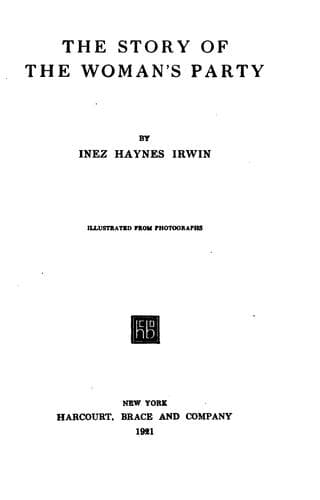
The Story of the Woman's PartyGillmore, Inez Haynes
History
The Story of the Woman's Party
Gillmore, Inez Haynes
National Woman's Party; Paul, Alice, 1885-1977; Women -- Suffrage -- United States
(“Why do you come here and bother us?”—Chairman Webb, at the Suffrage
hearing in Washington.)
Girls, girls, the worst has happened;
Our cause is at its ebb.
How could you go and do it!
You’ve bothered Mr. Webb!
You came and asked for freedom,
(As law does not forbid)
Not thinking it might bother him,
And yet, it seems, it did.
Oh, can it be, my sisters,
My sisters can it be,
You did not think of Mr. Webb
When asking to be free?
You did not put his comfort
Before your cause? How strange!
But now you know the way he feels
I hope we’ll have a change.
Send word to far Australia
And let New Zealand know,
And Oregon and Sweden,
Finland and Idaho;
Make all the nations grasp it,
From Sitka to El Teb,
We never mention Suffrage now;
It bothers Mr. Webb!
ALICE DUER MILLER.
OUR IDEA OF NOTHING AT ALL
(“I am opposed to Woman Suffrage, but I am not opposed to
woman.”—Anti-Suffrage speech of Mr. Webb of North Carolina.)
Oh, women, have you heard the news
Of charity and grace?
Look, look, how joy and gratitude
Are beaming in my face!
For Mr. Webb is not opposed
To woman in her place!
Oh, Mr. Webb, how kind you are
To let us live at all,
To let us light the kitchen range
And tidy up the hall;
To tolerate the female sex
In spite of Adam’s fall.
Oh, girls, suppose that Mr. Webb
Should alter his decree!
Suppose he were opposed to us—
Opposed to you and me.
What would be left for us to do—
Except to cease to be?
ALICE DUER MILLER.
DURING 1916, the central department of the Congressional Union—the
legislative—was in the hands of Anne Martin who after her notable
success in making Nevada a free State and with the added advantage of
being a voter herself, was particularly fitted for this work. Anne
Martin showed extraordinary ability in building back-fires in
Congressional Districts, in keeping State and district chairmen informed
of the actions of the representatives, in getting pressure from home
upon them and in organizing the lobbying. Maud Younger, as chairman of
the Lobby Committee, composed of women voters, assisted her. Lucy Burns
edited the _Suffragist_.
Public-domain text, read in full here on John Shaqi.
Reviews
Reviews
No reviews yet
Be the first to share your thoughts on this work.
Elsewhere in the archive
Join the Discussion
Join the discussion
Sign in to leave a comment or review.
Sign InorCreate an account