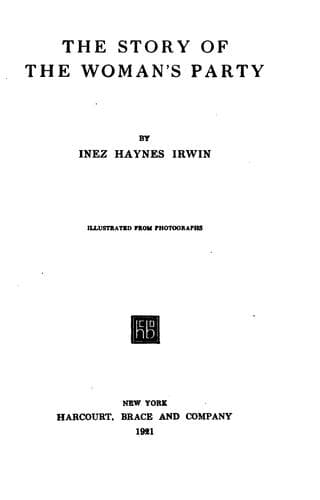
The Story of the Woman's PartyGillmore, Inez Haynes
History
The Story of the Woman's Party
Gillmore, Inez Haynes
National Woman's Party; Paul, Alice, 1885-1977; Women -- Suffrage -- United States
“You told me that you were in favor of having this matter remain in
committee until December, because you felt it would be embarrassing
to some men who would run for office next fall. As a
trades-unionist, as well as a woman voter, I feel that the eight
million working women of this country are entitled to as much
consideration as are a few politicians.”
Miss Younger then introduced Mrs. Lowell Mellett, of Seattle,
Washington; Mrs. William Kent, of California; Mrs. Gilson Gardner,
Mrs. Charles Edward Russell, of Illinois; Anne Martin, of Nevada;
each of whom made an appeal to Mr. Williams to give his support to a
report from the Judiciary Committee during the present session.
Miss Martin said:
You are in what seems to us a very undesirable position. You are a
Representative from a Suffrage State, from a State where women have
the right to vote for President. You are a professed Suffragist, yet
you are the only member of that committee who is a Suffragist and
who is in the position of having voted with the professed
anti-Suffragists against a hearing.... We urge you to do everything
in your power to reconsider the smothering of this resolution, and
bring up the question in committee again as soon as possible, to
report it to the House and then to leave to the Rules Committee the
question of what time it shall have for discussion in this session.
We urge this most earnestly.
Mr. Williams replied:
I am pleased to hear from you ladies and to know fully your side of
this case.
If I remember correctly the conversation you refer to in which I
spoke of some embarrassment—not to myself, but to some of my
colleagues—I think I stated the condition of the calendar and the
business of this session. I have not double-crossed anybody. I have
not taken any sudden change of front. I have told every
representative of the Suffrage organization who has visited me that
I do not favor a report at this first session of the Sixty-fourth
Congress. I gave, as my primary reason, the crowded condition of the
business of this Congress. I incidentally—sometimes in a
good-natured way, as I remember—stated that it did not embarrass me
to vote on the question because I was already on record, but it
might embarrass some of my colleagues. My real views have been that
Congress has duties in this, a campaign year, when all members hope
to leave at a reasonable time within which to make their campaign;
that this session is not a good time to take upon ourselves the
consideration of any unimportant question that can be disposed of
just as well at the next session.
Public-domain text, read in full here on John Shaqi.
Reviews
Reviews
No reviews yet
Be the first to share your thoughts on this work.
Elsewhere in the archive
Join the Discussion
Join the discussion
Sign in to leave a comment or review.
Sign InorCreate an account