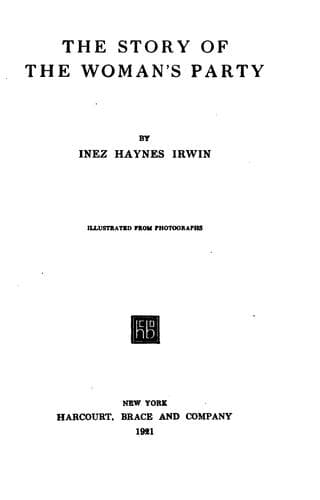
The Story of the Woman's PartyGillmore, Inez Haynes
History
The Story of the Woman's Party
Gillmore, Inez Haynes
National Woman's Party; Paul, Alice, 1885-1977; Women -- Suffrage -- United States
This confirmed our fears. Every one else was present; Mr. Taggart
was not in his office; no one knew where he was. Ten-thirty came;
ten forty-five. There was nothing of the vanquished in the faces of
our opponents. Mr. Carlin grinned affably at all of us, and the grin
chilled us. We looked anxiously from one to another as the meeting
began. Ten supporters—ten opponents. Mr. Taggart, wherever he was,
had our majority. The minutes dragged. Our friends prolonged the
preliminaries. A stranger near me pulled out his watch. I leaned
over and asked the time. “Five minutes to eleven.” And just at that
moment, looking up, I saw Mr. Taggart in the doorway—Mr. Taggart,
very much of a self-satisfied, naughty little boy, smiling
triumphantly. That did not matter. Our majority was complete.
The committee went into executive session, and we moved to the
anteroom. “A few minutes and you’ll have your Amendment reported
out,” said the newspaper men. “It’s all over but the shouting.” The
situation was ours. Suffrage was the special order; nothing could be
considered before it, and we had a majority. As the moments passed
we repeated this, trying to keep up our courage. For time lengthened
out. We eyed the door anxiously, starting up when it opened. We
caught glimpses of the room. The members were not sitting at their
places, they were on their feet, shaking their fists.
“They’re like wild animals,” said one member who came out.
“But what’s happening?” There was no answer. The door closed again.
Slowly we learned the incredible fact. When the door had shut upon
us, Mr. Carlin immediately moved that _all constitutional amendments
be indefinitely postponed_.
Now there were many constitutional amendments before that committee,
covering many subjects: marriage, divorce, election of judges, a
national anthem, prohibition. Mr. Carlin, to defeat us, had thrown
them all into one heap. A man could not vote to postpone one without
voting to postpone them all. He could not vote against one without
voting against them all. Were these men actually adult human beings,
legislating for a great nation, for the welfare of a hundred million
people?
The motion threw the committee into an uproar. Our friends protested
that it could not be considered; Suffrage was the special order of
the day. Mr. Moss moved that the Suffrage Amendment be reported out.
The chairman ruled this out of order. Now there was a majority in
that committee for Suffrage and a majority for prohibition, but they
were not the same majority. One of the strongest Suffragists
represented St. Louis with its large breweries. If he voted against
postponing the Prohibition Amendment he could never again be
re-elected from St. Louis. Yet he could not vote to postpone it
without postponing Suffrage also.
Public-domain text, read in full here on John Shaqi.
Reviews
Reviews
No reviews yet
Be the first to share your thoughts on this work.
Elsewhere in the archive
Join the Discussion
Join the discussion
Sign in to leave a comment or review.
Sign InorCreate an account