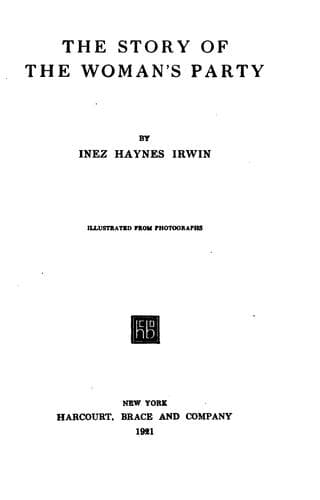
The Story of the Woman's PartyGillmore, Inez Haynes
History
The Story of the Woman's Party
Gillmore, Inez Haynes
National Woman's Party; Paul, Alice, 1885-1977; Women -- Suffrage -- United States
Resolved by the Senate and House of Representatives of the United
States of America in Congress assembled (two-thirds of each House
concurring therein) that the following article be proposed in the
legislatures of the several States as an Amendment to the
Constitution of the United States, which, when ratified by
three-fourths of the said legislatures, shall be valid as part of
such Constitution, namely:
Article 1, Section 1. The right of citizens of the United States to
vote shall not be denied or abridged by the United States or by any
State on account of sex.
Section 2. Congress shall have power, by appropriate legislation, to
enforce the provisions of this article.
The National Woman’s Party, convinced that the enfranchisement of
women is the paramount issue, pledges itself to use its united vote
to secure the passage of the Susan B. Anthony Amendment,
irrespective of the interests of any national political Party, and
pledges its unceasing opposition to all who oppose this Amendment.
Sara Bard Field closed that first meeting with an eloquent invocation to
the spirit of freedom, quoting from Alfred Wallace the words he used
just before his death:
All my long life and investigations have shown me that there is one
supreme force needed in the universe for growth, either material or
spiritual, physical or mental—and that force is freedom.
An evening session of the Woman’s Party Convention, held also at the
Blackstone Theatre, was made interesting and picturesque by the presence
of representatives of all the political Parties.
The Convention appointed women representing the Woman’s Party, to speak
at the Republican, Democratic, and Progressive Conventions.
Incidental to the Convention a big “Suffrage First” luncheon was given
in the Auditorium Hotel. So many hundreds of applicants for tickets had
to be refused that finally tickets of admission for standing room were
sold. Every inch of steps was occupied when the luncheon began.
Remarkable speeches were made by Rheta Childe Dorr, the famous
publicist, and one of the early editors of the _Suffragist_; by Crystal
Eastman, one of the founders of the Congressional Union, brilliant
speaker, writer, and editor; Inez Milholland Boissevain, who, before the
year was out, was to end, with such tragic abruptness, a vivid and
devoted life; Helen Keller, whose unexampled achievement is known to the
whole world.
The publicity which the Woman’s Party received was extraordinary. The
Convention lasted three days and the meetings were packed. Arthur
Brisbane pointed out the difference between the clock-like organization
of the women and the hap-hazard organization of the men.
Ida M. Tarbell, describing the Woman’s Party in the _New York World_ of
June 7 and 8, 1916, says:
Public-domain text, read in full here on John Shaqi.
Reviews
Reviews
No reviews yet
Be the first to share your thoughts on this work.
Elsewhere in the archive
Join the Discussion
Join the discussion
Sign in to leave a comment or review.
Sign InorCreate an account