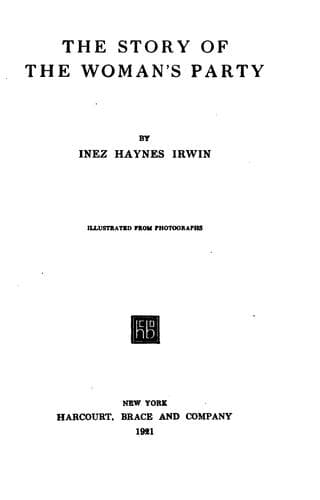
The Story of the Woman's PartyGillmore, Inez Haynes
History
The Story of the Woman's Party
Gillmore, Inez Haynes
National Woman's Party; Paul, Alice, 1885-1977; Women -- Suffrage -- United States
And then something happened. A great question arose in this country
which, though complicated with legal elements, was at the bottom a
human question, and nothing but a question of humanity. That was the
slavery question, and is it not significant that it was then, and
then for the first time, that women became prominent in politics in
America? Not many women. Those prominent in that day are so few that
you can almost name them over in a brief catalogue, but
nevertheless, they then began to play a part in writing not only,
but in public speech, which was a very novel part for women to play
in America; and after the Civil War had settled some of what seemed
the most difficult legal questions of our system, the life of the
nation began not only to unfold but to accumulate.
Life in the United States was a comparatively simple matter at the
time of the Civil War. There was none of that underground struggle
which is now so manifest to those who look only a little way beneath
the surface. Stories such as Dr. Davis has told tonight were
uncommon in those simpler days.
The pressure of low wages, the agony of obscure and unremunerated
toil did not exist in America in anything the same proportions that
they exist now. And as our life has unfolded and accumulated, as the
contacts of it have become hot, as the populations have assembled in
the cities, and the cool spaces of the country have been supplanted
by the feverish urban areas, the whole nature of our political
questions has been altered. They have ceased to be legal questions.
They have more and more become social questions—questions with
regard to the relations of human beings to one another—not merely
their legal relations, but their moral and spiritual relations to
one another.
And this has been most characteristic of American life in the last
few decades, and as these questions have assumed greater and greater
prominence, the movement which this association represents has
gathered cumulative force. So that if anybody asks himself, “What
does this gathering force mean?” if he knows anything about the
history of the country, he knows that it means something that has
not only come to stay, but has come with conquering power.
I get a little impatient sometimes about the discussion of the
channels and methods by which it is to prevail. It is going to
prevail, and that is a very superficial and ignorant view of it
which attributes it to mere social unrest. It is not merely because
the women are discontented. It is because the women have seen
visions of duty, and that is something which we not only cannot
resist, but, if we be true Americans, we do not wish to resist.
So that what we have to realize in dealing with forces of this sort
is that we are dealing with the substance of life itself.
Public-domain text, read in full here on John Shaqi.
Reviews
Reviews
No reviews yet
Be the first to share your thoughts on this work.
Elsewhere in the archive
Join the Discussion
Join the discussion
Sign in to leave a comment or review.
Sign InorCreate an account