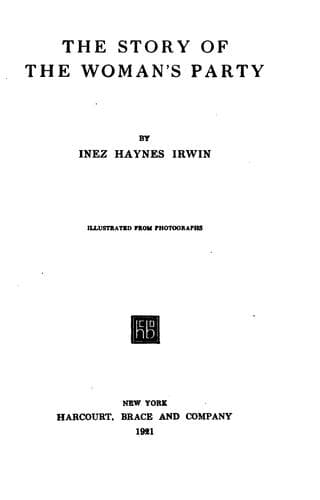
The Story of the Woman's PartyGillmore, Inez Haynes
History
The Story of the Woman's Party
Gillmore, Inez Haynes
National Woman's Party; Paul, Alice, 1885-1977; Women -- Suffrage -- United States
Immediately the campaign began. It was the biggest campaign—the most
important ever waged by the Woman’s Party. A stream of organizers
started for the Western States to prepare the way for the speakers. How
hard, and how long, and how intensively these girl organizers worked
will never be known because, in the very nature of things, there could
be no adequate record of their efforts. Then came a stream of speakers,
relay after relay—convinced, informed, experienced—and inspired. Among
them were Harriot Stanton Blatch, Sara Bard Field, Ida Finney Mackrille,
Mrs. William Kent, Mrs. H. O. Havemeyer, Helen Todd, Maud Younger, Rose
Winslow, and Gail Laughlin. The brilliant, beautiful Inez Milholland
Boissevain, doomed soon to die so untimely but so glorious a death, was
appointed special flying envoy to make a twelve mile swing through the
twelve western Equal Suffrage States; to bring to the enfranchised women
of the West an appeal for help from the disfranchised women of the East.
The campaign of 1916 was characterized by the swiftness of attack and
efficiency of method which characterized the campaign of 1914, but it
was carried out on a much larger scale. In Washington, Headquarters
boiled ... bubbled ... seethed....
From Washington there sifted into the West tons of campaign literature:
miles of purple, white, and gold banners; acres of great
across-the-street streamers. In the West itself, Woman’s Party speakers
addressed every kind of meeting known to our civilization: indoor
meetings; outdoor meetings; luncheons; banquets; labor unions; business
men’s organizations; in churches, factories, theatres; at mining camps,
county fairs. They took advantage of impromptu meetings in the streets;
small ready-made meetings at clubs; large advertised mass-meetings. And
Inez Milholland’s activities as a flying envoy—and in that, her last
flight she did fly—were the climax of it all.
The slogan of the Wilson party was, “He kept us out of war.” The slogan
of the Woman’s Party developed, “He kept us out of Suffrage.”
The Democrats, remembering the results of the campaign of 1914, were far
from indulgent of this small army, the members of which were all
generals.
In Denver, Elsie Hill the Woman’s Party organizer was arrested and
hurried to the police station in a patrol wagon. The only charge against
her was that she had distributed literature telling the Democratic
record on Suffrage.
In Colorado Springs, the Federal Amendment banner was “arrested” and
locked up for the night in jail.
Public-domain text, read in full here on John Shaqi.
Reviews
Reviews
No reviews yet
Be the first to share your thoughts on this work.
Elsewhere in the archive
Join the Discussion
Join the discussion
Sign in to leave a comment or review.
Sign InorCreate an account