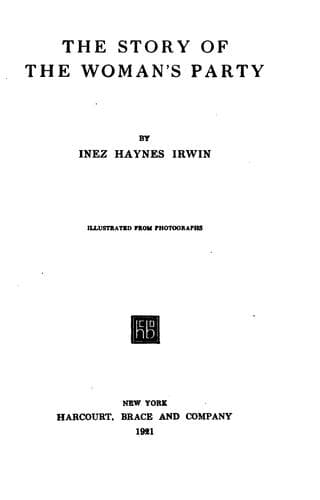
The Story of the Woman's PartyGillmore, Inez Haynes
History
The Story of the Woman's Party
Gillmore, Inez Haynes
National Woman's Party; Paul, Alice, 1885-1977; Women -- Suffrage -- United States
Tune (Scotch):
“Charlie Is My Darling.”
Shout the Revolution
Of Women, of Women,
Shout the Revolution
Of Liberty.
Rise, glorious women of the earth,
The voiceless and the free,
United strength assures the birth
Of True Democracy.
Invincible our army,
Forward, forward,
Strong in faith we’re marching
To Victory.
Shout the Revolution
Of Women, of Women,
Shout the Revolution
Of Liberty.
Men’s revolutions born in blood
But ours conceived in peace
We hold a banner for a sword,
’Til all oppression cease,
Prison, death defying,
Onward, onward,
Triumphant daughters marching
To Victory.
The preceding two chapters have been concerned mainly with the treatment
of the pickets at the hands of the law. We now approach a much graver
matter—their treatment at the hands of the prison authorities. This
chapter describes what is one of the most disgraceful episodes in the
history of the United States. It is futile to argue that what happened
in the District Jail and at Occoquan Workhouse, and later at the
abandoned Workhouse, was unknown to the Administration. The Suffragists,
indeed, published it to the entire country. That the treatment to which
the pickets were subjected was the result of orders from above is almost
demonstrable. It must be remembered that the officials who are
responsible for what happened to the pickets—the three Commissioners who
govern the District of Columbia, the police court judges, the Chief of
Police, the warden of the jail, the superintendent of Occoquan
Workhouse, are directly or indirectly answerable to the President.
* * * * *
When the first pickets came out of prison (arrested on June 27, 1917),
their spirit was that of women who have willingly gone to jail for a
cause—and was in consequence entirely without self-pity.
In a speech at a breakfast tendered them in the garden at Headquarters,
Mabel Vernon sounded this note:
_I_ do not want any one here to think we have been martyrs because
of this jail experience we have had. There was no great hardship
connected with it. It was a very simple thing to do—to be imprisoned
for three days, really two nights and a day. Do not think we have
gone through any great sacrifices.
But I do not feel patient about this experience. I do not want to go
back to jail, and I do not want others to go, _because it should not
be necessary_.
Public-domain text, read in full here on John Shaqi.
Reviews
Reviews
No reviews yet
Be the first to share your thoughts on this work.
Elsewhere in the archive
Join the Discussion
Join the discussion
Sign in to leave a comment or review.
Sign InorCreate an account