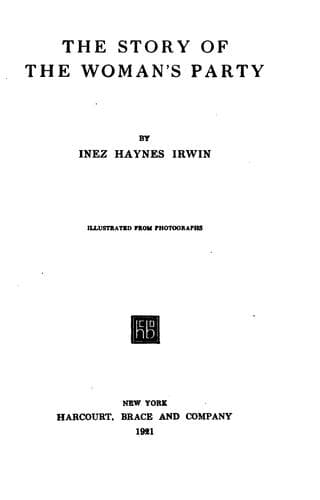
The Story of the Woman's PartyGillmore, Inez Haynes
History
The Story of the Woman's Party
Gillmore, Inez Haynes
National Woman's Party; Paul, Alice, 1885-1977; Women -- Suffrage -- United States
Found that while the institution was supposed to build and improve
inmates, they were ordinarily not allowed any recreation nor proper
cleanliness. No classes were held, and no teaching of any sort was
attempted. They were deprived of all parcels, and mail was usually
withheld both coming and going. Visitors and attorneys were held up,
and the prisoners usually absolutely shut away from help.
Found that no rules governing the rights of the prisoners had been
codified by the Congressional Committee responsible for the
institution, and was told by the superintendent that the prisoners
had no rights and that the superintendent could treat the inmates as
he liked.
Under that management, the matrons, while apparently ordinarily
decent and often making a good first impression, were found to be
brutal and unreasonable in their care of inmates.
The inmates were driven, abused, insulted. They were not allowed to
speak in the dining-room or workrooms or dormitories. It was a place
of chicanery, sinister horror, brutality, and dread.
No one could go there for a stay who would not be permanently
injured. No one could come out without just resentment against any
government which could maintain such an institution.
As has been told before Judge Waddill decided that the pickets had been
illegally transferred from the Jail to Occoquan and they were sent back
to the Jail. But between Occoquan and Jail occurred one night, in which
the pickets were released in the custody of Dudley Field Malone, their
counsel. They went immediately to Cameron House and broke their
hunger-strike—spent the evening before the fire, talking and sipping hot
milk. The next day they were committed to jail again and immediately
started a new hunger-strike.
The government, however, undoubtedly appalled by the protests that came
from all over the country, and perhaps, in addition, staggered at the
prospect of forcibly feeding so many women, released them all three days
later.
A mass-meeting was held at the Belasco Theatre early in December to
welcome them. The auditorium was crowded and there was an overflow
meeting of four thousand outside on the sidewalk. The police reserves,
who had so often, in previous months, come out to arrest pickets, now
came out to protect them from the thousands of people who gathered in
their honor. Elsie Hill addressed this overflow meeting, which shivered
in the bitter cold for over an hour, yet stayed to hear her story.
Public-domain text, read in full here on John Shaqi.
Reviews
Reviews
No reviews yet
Be the first to share your thoughts on this work.
Elsewhere in the archive
Join the Discussion
Join the discussion
Sign in to leave a comment or review.
Sign InorCreate an account