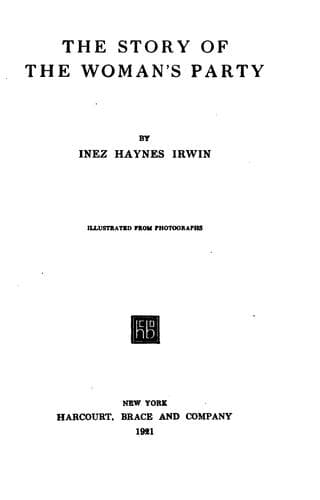
The Story of the Woman's PartyGillmore, Inez Haynes
History
The Story of the Woman's Party
Gillmore, Inez Haynes
National Woman's Party; Paul, Alice, 1885-1977; Women -- Suffrage -- United States
The lobbying for the Woman’s Party was directed at first by Alice Paul
and Lucy Burns. Mrs. Gilson Gardner was the pioneer lobbyist, and the
first-year lobbyists were all women voters. They made reports to Alice
Paul and Lucy Burns every day. First these were oral; later they were
written. This was the nucleus of the Woman’s Party card catalogue which
has since become so famous. Finally, these written reports were put in
tabulated form by Mrs. Grimes of Michigan.
As the work grew, unenfranchised women lobbied as often as enfranchised.
The early lobbyists were: Mrs. Gilson Gardner, Mrs. William Kent, Mrs.
George Odell, Lucy Burns, Abby Scott Baker, Mrs. Lowell Mellett. But not
only the experienced lobbied. As has before been set down—following that
wise instinct which impelled Alice Paul to give her workers glimpses of
all phases of the movement—as fast as the organizers came back to
Washington, she sent them up to the galleries of Congress to listen; she
made them lobby for a while. And, as has elsewhere been stated, this was
found to be a mutual benefit. Organizers took the temper and atmosphere
of Congress back to the States, and sometimes to the very constituents
of the Congressmen with whom they had talked; they put Congressmen in
touch with what was happening at home. Whenever a woman visiting
Washington called at Headquarters, Alice Paul immediately sent her to
the Capitol to lobby the Congressmen and Senators of her own State.
In November, 1915, Anne Martin, as Chairman of the Legislative
Department, became the head of the lobbying. Miss Martin is a born
general. She brought to this situation an instinct for the strategy and
tactics of politics. She supervised the work of those who were under
her, sent them up to Congress with specific directions; received their
reports; collated them; made suggestions for the next day’s work;
developed a closer relation with the constituents and kept local
chairmen in touch with the States of their own Congressmen and Senators.
In 1916, Anne Martin ran for Senator in Nevada. She had of necessity to
relinquish active work in Washington for the Woman’s Party.
In the spring of 1916, therefore, Maud Younger who was in a position to
give her whole time to it, became Chairman of the Lobby Committee and
chief lobbyist for the Amendment.
At all times this work was hard, and sometimes intensely disagreeable.
Maud Younger in her _Revelations of a Woman Lobbyist_, gives some of the
actual physical strain. She says:
Public-domain text, read in full here on John Shaqi.
Reviews
Reviews
No reviews yet
Be the first to share your thoughts on this work.
Elsewhere in the archive
Join the Discussion
Join the discussion
Sign in to leave a comment or review.
Sign InorCreate an account