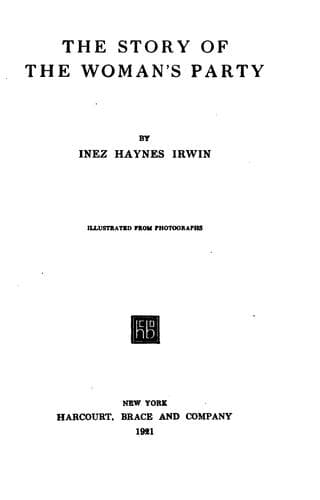
The Story of the Woman's PartyGillmore, Inez Haynes
History
The Story of the Woman's Party
Gillmore, Inez Haynes
National Woman's Party; Paul, Alice, 1885-1977; Women -- Suffrage -- United States
I stood still. It was but the second time we had spoken to him since
he had come to the Senate. I wondered if he thought we liked
“nagging”; if we liked going to the Capitol day after day, tramping
on marble floors, waiting in ante-rooms—sometimes rebuffed,
sometimes snarled at. I wondered if he thought we could do it for
anything but a great cause—for the thousands of women toiling in the
factories, for the thousands struggling under burdens at home. And
then I bit my lips to keep back the tears, and putting aside such
uncomfortable things as feelings, and putting forward such solacing
things as a lace jabot and a smile, I sent for another Senator.
Senator Martin, of silvery white hair and determined manner would
not sit down and talk Suffrage, nor would he stand up and talk
Suffrage. The only way to discuss Suffrage with Senator Martin was
to run beside him down the hall.
“The good women of Virginia do not want Suffrage,” he said, breaking
almost into a trot, with eyes on his goal, which was an elevator.
“But if you were convinced that the good women of Virginia do want
it?” you replied, breaking almost into a run, with your eyes on him.
“It’s only the professional agitators I hear from,” he answered.
It is interesting to talk Suffrage with Senator Martin, and very
good exercise. But it was still more interesting to watch a
deputation of good Virginia women talking to him.
“Every one knows where I stand, and yet the ladies waylay me all
about the halls,” he complained. Yet when we had spoken before the
Platform Committee of the Democratic Convention in St. Louis, he
told me: “I said to those men, ‘There isn’t an equal number of you
that could make as good speeches as those women made.’” So he was
not to be considered as hopeless, though the path to his salvation
was a strenuous one.
In June, Carrie Chapman Catt, President of the International Woman
Suffrage Alliance, transmitted to the President a memorial from the
French Union for Woman Suffrage asking him in one of his messages to
proclaim the principle of Woman Suffrage to be one of the fundamental
rights of the future.
The President replied in the following letter:
I have read your message with the deepest interest, and I welcome
the opportunity to say that I agree, without reservation, that the
full and sincere democratic reconstruction of the world, for which
we are striving, and which we are determined to bring about at any
cost, will not have been completely or adequately attained until
women are admitted to the Suffrage. And that only by this action can
the nations of the world realize for the benefit of future
generations the full ideal force of opinion, or the full humane
forces of action.
Public-domain text, read in full here on John Shaqi.
Reviews
Reviews
No reviews yet
Be the first to share your thoughts on this work.
Elsewhere in the archive
Join the Discussion
Join the discussion
Sign in to leave a comment or review.
Sign InorCreate an account