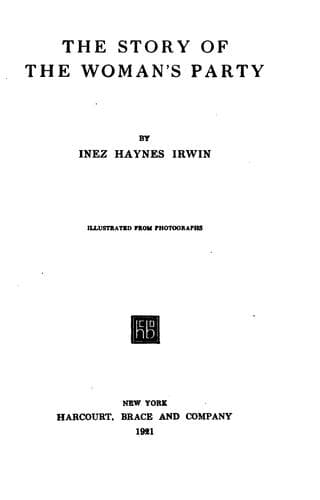
The Story of the Woman's PartyGillmore, Inez Haynes
History
The Story of the Woman's Party
Gillmore, Inez Haynes
National Woman's Party; Paul, Alice, 1885-1977; Women -- Suffrage -- United States
I do not speak by conjecture. It is not alone the voices of
statesmen and of newspapers that reach me, and the voices of foolish
and intemperate agitators do not reach me at all. Through many, many
channels I have been made aware what the plain, struggling, workaday
folk are thinking upon whom the chief terror and suffering of this
tragic war falls.
They are looking to the great, powerful, famous Democracy of the
West to lead them to the new day for which they have so long waited;
and they think in their logical simplicity, that democracy means
that women shall play their part in affairs alongside men and upon
an equal footing with them. If we reject measures like this, in
ignorance or defiance of what a new age has brought forth, of what
they have seen but we have not, they will cease to believe in us;
they will cease to follow or to trust us.
They have seen their own governments accept this interpretation of
democracy—seen old governments accept this interpretation of
democracy—seen old governments like that of Great Britain, which did
not profess to be democratic, promise readily and as of course this
justice to women, though they had before refused it, the strange
revelations of this war having made many things new and plain, to
governments as well as to people.
Are we alone to refuse to learn the lesson? Are we alone to ask and
take the utmost that our women can give—service and sacrifice of
every kind—and still say we do not see what title that gives them to
stand by our sides in the guidance of the affairs of their nation
and ours?
We have made partners of the women in this war; shall we admit them
only to a partnership of suffering and sacrifice and toil and not a
partnership of privilege and right? This war could not have been
fought either by the other nations engaged or by America, if it had
not been for the services of the women—services rendered in every
sphere—not merely in the fields of effort in which we have been
accustomed to see them work, but wherever men have worked, and upon
the very skirts and edges of the battle itself.
We shall not only be distrusted but shall deserve to be distrusted
if we do not enfranchise them with the fullest possible
enfranchisement, as it is now certain that the other great free
nations will enfranchise them.
We cannot isolate our thought and action in such a matter from the
thought of the rest of the world. We must either conform or
deliberately reject what they propose and resign the leadership of
liberal minds to others.
The women of America are too noble and too intelligent and too
devoted to be slackers whether you give or withhold this thing that
is mere justice; but I know the magic it will work in their thoughts
and spirits if you give it to them.
Public-domain text, read in full here on John Shaqi.
Reviews
Reviews
No reviews yet
Be the first to share your thoughts on this work.
Elsewhere in the archive
Join the Discussion
Join the discussion
Sign in to leave a comment or review.
Sign InorCreate an account