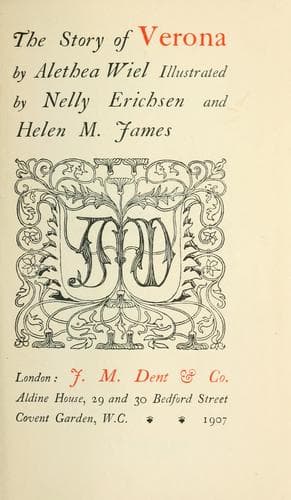
Verona (Italy) -- Description and travel; Verona (Italy) -- History
[13] J. A. Symonds, _Age of the Despots_. London, Smith, Elder & Co.,
1898, ch. iii., p. 83, &c.
[14]
“Tenne ambo le chiavi
Del cuor di Federigo.”--_Inf._ xiii. 58-59.
[15] “Tiranni Che diér nel Sangue e nell’ aver di piglio.”--_Inf._
xii. 104-105
[16] I am aware that I am destroying a legend that has found its way
into nearly every guide-book and even into some histories of Verona by
this assertion. But no Veronese of any culture or learning supports
the popular tradition, or admits that the deed aroused such horror
in the public mind as to brand the spot with a special name. The
“Volto Barbaro” simply took its name from the Barbaro family who lived
there, as the “Volto Marioni” in another part of the town did from the
Marioni family--a fact that no one versed in Veronese matters would
ever seek to gainsay or dispute.
[17] Giuseppe Biadego, _Dante e gli Scaligeri_, Venezia, 1899.
[18] _See_ Cipolla, _op. cit._ p. 208.
[19]
“Thine earliest refuge and thine earliest inn
Shall be the mighty Lombard’s courtesy,
Who on the ladder bears the holy bird,
Who such benign regard shall have for thee
That ’twixt you twain, in doing and in asking,
That shall be first which is with others last.
With him shalt thou see one who at his birth
Has by this star of strength been so impressed,
That notable shall his achievements be.”
_Paradiso_, canto xvii., 76, &c.
(Longfellow’s Translation).
[20] Giuseppe Biadego, _op. cit._, p. 12.
[21] _Op. cit._, p. 13.
[22] Boccaccio, Giornata I., Novella VII.
[23] Gio. Villani, _Istorie fiorentine_, lib. x., cap. 139.
[24] I have taken this translation from the Notes on the _Paradiso_,
given in Longfellow’s translation of the _Divine Comedy_ (London,
1877). From there, too, have I taken the extract from Petrarch, which
is to be found in Balbo’s _Life of Dante_, translated by Mrs Bunbury,
ii. 207.
[25]
Ch’io veggio certamente, e perŏ il narro,
A darne tempo, gia stelle propinque,
Sicure d’ogni intoppo e d’ogni sbarro;
Nel quale un cinquecento diece e cinque,
Messo di Dio, ancideră la fuja
Conquel gigante che con lei delinque.
[26] Vernon, Hon. William Warren, _Readings on the Purgatorio of
Dante_. London, Macmillan, 1889, vol. ii., p. 429, &c.
[27] _Rithmi de obitu Henrici VII._, _ed. Freher_, _Germanie-rerum
Scriptores_, i. 15, etc.
[28] Cipolla, C, _Storia delle Signorie italiani dal 1313 al 1350_.
Milano, 1881, lib. i. iv.
[29] I have not gone into the lengthy and vexed question of the date
of Cangrande’s birth. The year generally accepted is 1291, and that I
have followed as the most probable one, and the one most deserving of
acceptance.
[30] Cipolla, _op. cit. lib._ i. iv.
[31] _Verona and other Lectures._ Allen, Orpington, 1894.
Public-domain text, read in full here on John Shaqi.
Reviews
Reviews
No reviews yet
Be the first to share your thoughts on this work.
Elsewhere in the archive
Join the Discussion
Join the discussion
Sign in to leave a comment or review.
Sign InorCreate an account