The Student's Elements of GeologyLyell, Charles, Sir
Science
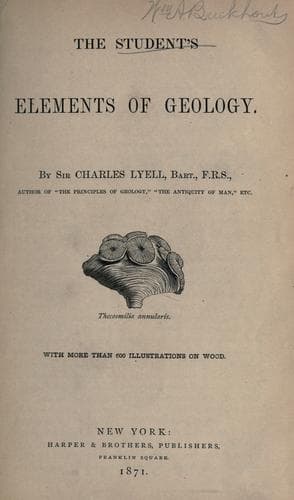
The Student's Elements of Geology
Lyell, Charles, Sir
Geology
Lapse of Time between Cretaceous and Eocene Periods. — Table of
successive Cretaceous Formations. — Maestricht Beds. — Pisolitic
Limestone of France. — Chalk of Faxoe. — Geographical Extent and Origin
of the White Chalk. — Chalky Matter now forming in the Bed of the
Atlantic. — Marked Difference between the Cretaceous and existing
Fauna. — Chalk-flints. — Pot-stones of Horstead. — Vitreous Sponges in
the Chalk. — Isolated Blocks of Foreign Rocks in the White Chalk
supposed to be ice-borne. — Distinctness of Mineral Character in
contemporaneous Rocks of the Cretaceous Epoch. — Fossils of the White
Chalk. — Lower White Chalk without Flints. — Chalk Marl and its
Fossils. — Chloritic Series or Upper Greensand. — Coprolite Bed near
Cambridge. — Fossils of the Chloritic Series. — Gault. — Connection
between Upper and Lower Cretaceous Strata. — Blackdown Beds. — Flora of
the Upper Cretaceous Period. — Hippurite Limestone. — Cretaceous Rocks
in the United States.
We have treated in the preceding chapters of the Tertiary or Cainozoic
strata, and have next to speak of the Secondary or Mesozoic formations.
The uppermost of these last is commonly called the chalk or the
cretaceous formation, from creta, the latin name for that remarkable
white earthy limestone, which constitutes an upper member of the group
in those parts of Europe where it was first studied. The marked
discordance in the fossils of the tertiary, as compared with the
cretaceous formations, has long induced many geologists to suspect that
an indefinite series of ages elapsed between the respective periods of
their origin. Measured, indeed, by such a standard, that is to say, by
the amount of change in the Fauna and Flora of the earth effected in
the interval, the time between the Cretaceous and Eocene may have been
as great as that between the Eocene and Recent periods, to the history
of which the last seven chapters have been devoted. Several deposits
have been met with here and there, in the course of the last half
century, of an age intermediate between the white chalk and the plastic
clays and sands of the Paris and London districts, monuments which have
the same kind of interest to a geologist which certain medieval records
excite when we study the history of nations. For both of them throw
light on ages of darkness, preceded and followed by others of which the
annals are comparatively well-known to us. But these newly-discovered
records do not fill up the wide gap, some of them being closely allied
to the Eocene, and others to the Cretaceous type, while none appear as
yet to possess so distinct and characteristic a fauna as may entitle
them to hold an independent place in the great chronological series.
Public-domain text, read in full here on John Shaqi.
Reviews
Reviews
No reviews yet
Be the first to share your thoughts on this work.
Elsewhere in the archive
Join the Discussion
Join the discussion
Sign in to leave a comment or review.
Sign InorCreate an account