The Student's Elements of GeologyLyell, Charles, Sir
Science
The Student's Elements of Geology
Lyell, Charles, Sir
Geology
In the same slate of Solenhofen a fine example was met with in 1862 of
the skeleton of a bird almost entire, and retaining even its feathers
so perfect that the vanes as well as the shaft are preserved. The head
was at first supposed to be wanting, but Mr. Evans detected on the slab
what seems to be the impression of the cranium and beak, much
resembling in size and shape that of the jay or woodcock. This valuable
specimen is now in the British Museum, and has been called by Professor
Owen _Archæopteryx macrura._ Although anatomists agree that it is a
true bird, yet they also find that in the length of the bones of the
tail, and some other minor points of its anatomy, it approaches more
nearly to reptiles than any known living bird. In the living
representatives of the class Aves, the tail-feathers are attached to a
coccygian bone, consisting of several vertebræ united together, whereas
in the Archæopteryx the tail is composed of twenty vertebræ, each of
which supports a pair of quill-feathers. The first five only of the
vertebræ, as seen in A, have transverse processes, the fifteen
remaining ones become gradually longer and more tapering. The feathers
diverge outward from them at an angle of 45°.
Fig. 321: Tail and feather of Archæopteryx, from Solenhofen, and tail
of living bird for comparison.
Professor Huxley in his late memoirs on the order of reptiles called
Dinosaurians, which are largely represented in all the formations, from
the Neocomian to the Trias inclusive, has shown that they present in
their structure many remarkable affinities to birds. But a reptile
about two feet long, called Compsognathus, lately found in the
Stonesfield slate, makes a much greater approximation to the class Aves
than any Dinosaur, and therefore forms a closer link between the
classes Aves and Reptilia than does the Archæopteryx.
It appears doubtful whether any species of British fossil, whether of
the vertebrate or invertebrate class, is common to the Oolite and
Chalk. But there is no similar break or discordance as we proceed
downward, and pass from one to another of the several leading members
of the Jurassic group, the Upper, Middle, and Lower Oolite, and the
Lias, there being often a considerable proportion of the mollusca,
sometimes as much as a fourth, common to such divisions as the Upper
and Middle Oolite.
MIDDLE OOLITE.
Coral Rag.—One of the limestones of the Middle Oolite has been called
the “Coral Rag,” because it consists, in part, of continuous beds of
petrified corals, most of them retaining the position in which they
grew at the bottom of the sea. In their forms they more frequently
resemble the reef-building polyparia of the Pacific than do the corals
of any other member of the Oolite. They belong chiefly to the genera
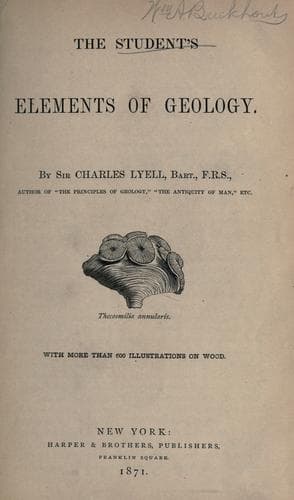
_Thecosmilia_ (Fig. 322), _Protoseris,_ and _Thamnastræa,_ and
sometimes form masses of coral fifteen feet thick.
Fig. 322: Thecosmilia annularis. Fig. 323: Thamnastræa.
Public-domain text, read in full here on John Shaqi.
Reviews
Reviews
No reviews yet
Be the first to share your thoughts on this work.
Elsewhere in the archive
Join the Discussion
Join the discussion
Sign in to leave a comment or review.
Sign InorCreate an account