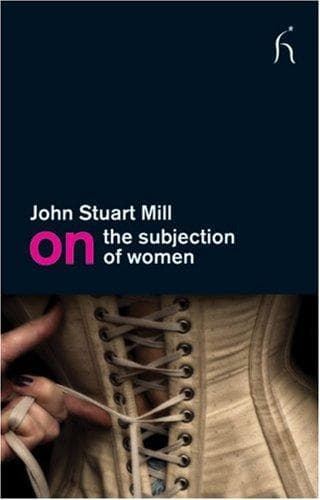
Women -- Social and moral questions; Women's rights
It no doubt often happens that a person, who has not widely and
accurately studied the thoughts of others on a subject, has by
natural sagacity a happy intuition, which he can suggest, but cannot
prove, which yet when matured may be an important addition to
knowledge: but even then, no justice can be done to it until some
other person, who does possess the previous acquirements, takes it in
hand, tests it, gives it a scientific or practical form, and fits it
into its place among the existing truths of philosophy or science. Is
it supposed that such felicitous thoughts do not occur to women? They
occur by hundreds to every woman of intellect. But they are mostly
lost, for want of a husband or friend who has the other knowledge
which can enable him to estimate them properly and bring them before
the world: and even when they are brought before it, they generally
appear as his ideas, not their real author's. Who can tell how many
of the most original thoughts put forth by male writers, belong to a
woman by suggestion, to themselves only by verifying and working out?
If I may judge by my own case, a very large proportion indeed.
If we turn from pure speculation to literature in the narrow sense of
the term, and the fine arts, there is a very obvious reason why
women's literature is, in its general conception and in its main
features, an imitation of men's. Why is the Roman literature, as
critics proclaim to satiety, not original, but an imitation of the
Greek? Simply because the Greeks came first. If women lived in a
different country from men, and had never read any of their writings,
they would have had a literature of their own. As it is, they have
not created one, because they found a highly advanced literature
already created. If there had been no suspension of the knowledge of
antiquity, or if the Renaissance had occurred before the Gothic
cathedrals were built, they never would have been built. We see that,
in France and Italy, imitation of the ancient literature stopped the
original development even after it had commenced. All women who write
are pupils of the great male writers. A painter's early pictures,
even if he be a Raffaelle, are undistinguishable in style from those
of his master. Even a Mozart does not display his powerful
originality in his earliest pieces. What years are to a gifted
individual, generations are to a mass. If women's literature is
destined to have a different collective character from that of men,
depending on any difference of natural tendencies, much longer time
is necessary than has yet elapsed, before it can emancipate itself
from the influence of accepted models, and guide itself by its own
impulses. But if, as I believe, there will not prove to be any
natural tendencies common to women, and distinguishing their genius
from that of men, yet every individual writer among them has her
individual tendencies, which at present are still subdued by the
Public-domain text, read in full here on John Shaqi.
Reviews
Reviews
No reviews yet
Be the first to share your thoughts on this work.
Elsewhere in the archive
Join the Discussion
Join the discussion
Sign in to leave a comment or review.
Sign InorCreate an account