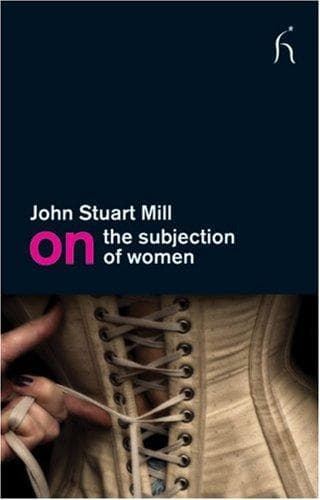
Women -- Social and moral questions; Women's rights
effects it produces, how can they be expected to foresee them? A
woman born to the present lot of women, and content with it, how
should she appreciate the value of self-dependence? She is not
self-dependent; she is not taught self-dependence; her destiny is to
receive everything from others, and why should what is good enough
for her be bad for the poor? Her familiar notions of good are of
blessings descending from a superior. She forgets that she is not
free, and that the poor are; that if what they need is given to them
unearned, they cannot be compelled to earn it: that everybody cannot
be taken care of by everybody, but there must be some motive to
induce people to take care of themselves; and that to be helped to
help themselves, if they are physically capable of it, is the only
charity which proves to be charity in the end.
These considerations show how usefully the part which women take in
the formation of general opinion, would be modified for the better by
that more enlarged instruction, and practical conversancy with the
things which their opinions influence, that would necessarily arise
from their social and political emancipation. But the improvement it
would work through the influence they exercise, each in her own
family, would be still more remarkable.
It is often said that in the classes most exposed to temptation, a
man's wife and children tend to keep him honest and respectable, both
by the wife's direct influence, and by the concern he feels for their
future welfare. This may be so, and no doubt often is so, with those
who are more weak than wicked; and this beneficial influence would be
preserved and strengthened under equal laws; it does not depend on
the woman's servitude, but is, on the contrary, diminished by the
disrespect which the inferior class of men always at heart feel
towards those who are subject to their power. But when we ascend
higher in the scale, we come among a totally different set of moving
forces. The wife's influence tends, as far as it goes, to prevent the
husband from falling below the common standard of approbation of the
country. It tends quite as strongly to hinder him from rising above
it. The wife is the auxiliary of the common public opinion. A man who
is married to a woman his inferior in intelligence, finds her a
perpetual dead weight, or, worse than a dead weight, a drag, upon
every aspiration of his to be better than public opinion requires him
to be. It is hardly possible for one who is in these bonds, to attain
exalted virtue. If he differs in his opinion from the mass--if he
sees truths which have not yet dawned upon them, or if, feeling in
his heart truths which they nominally recognise, he would like to act
up to those truths more conscientiously than the generality of
mankind--to all such thoughts and desires, marriage is the heaviest
of drawbacks, unless he be so fortunate as to have a wife as much
above the common level as he himself is.
Public-domain text, read in full here on John Shaqi.
Reviews
Reviews
No reviews yet
Be the first to share your thoughts on this work.
Elsewhere in the archive
Join the Discussion
Join the discussion
Sign in to leave a comment or review.
Sign InorCreate an account