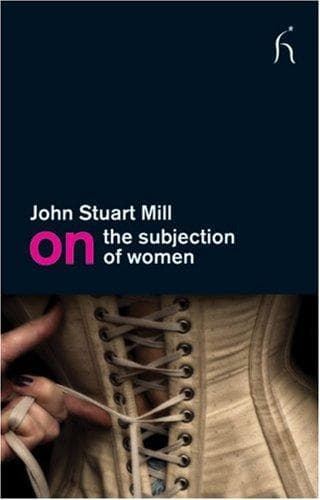
Women -- Social and moral questions; Women's rights
It would of course be extreme folly to suppose that these differences
of feeling and inclination only exist because women are brought up
differently from men, and that there would not be differences of
taste under any imaginable circumstances. But there is nothing beyond
the mark in saying that the distinction in bringing-up immensely
aggravates those differences, and renders them wholly inevitable.
While women are brought up as they are, a man and a woman will but
rarely find in one another real agreement of tastes and wishes as to
daily life. They will generally have to give it up as hopeless, and
renounce the attempt to have, in the intimate associate of their
daily life, that _idem velle, idem nolle_, which is the recognised
bond of any society that is really such: or if the man succeeds in
obtaining it, he does so by choosing a woman who is so complete a
nullity that she has no _velle_ or _nolle_ at all, and is as ready to
comply with one thing as another if anybody tells her to do so. Even
this calculation is apt to fail; dulness and want of spirit are not
always a guarantee of the submission which is so confidently expected
from them. But if they were, is this the ideal of marriage? What, in
this case, does the man obtain by it, except an upper servant, a
nurse, or a mistress? On the contrary, when each of two persons,
instead of being a nothing, is a something; when they are attached to
one another, and are not too much unlike to begin with; the constant
partaking in the same things, assisted by their sympathy, draws out
the latent capacities of each for being interested in the things
which were at first interesting only to the other; and works a
gradual assimilation of the tastes and characters to one another,
partly by the insensible modification of each, but more by a real
enriching of the two natures, each acquiring the tastes and
capacities of the other in addition to its own. This often happens
between two friends of the same sex, who are much associated in their
daily life: and it would be a common, if not the commonest, case in
marriage, did not the totally different bringing-up of the two sexes
make it next to an impossibility to form a really well-assorted
union. Were this remedied, whatever differences there might still be
in individual tastes, there would at least be, as a general rule,
complete unity and unanimity as to the great objects of life. When
the two persons both care for great objects, and are a help and
encouragement to each other in whatever regards these, the minor
matters on which their tastes may differ are not all-important to
them; and there is a foundation for solid friendship, of an enduring
character, more likely than anything else to make it, through the
whole of life, a greater pleasure to each to give pleasure to the
other, than to receive it.
Public-domain text, read in full here on John Shaqi.
Reviews
Reviews
No reviews yet
Be the first to share your thoughts on this work.
Elsewhere in the archive
Join the Discussion
Join the discussion
Sign in to leave a comment or review.
Sign InorCreate an account