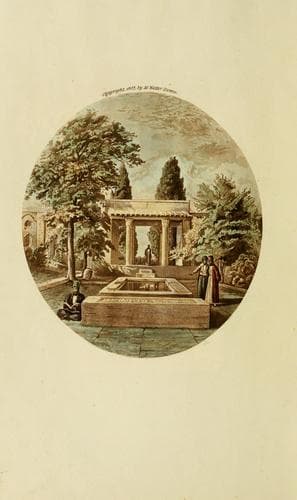
The Sufistic Quatrains of Omar KhayyamOmar Khayyam
ReligionSufism
The Sufistic Quatrains of Omar Khayyam
Omar Khayyam
FitzGerald, Edward, 1809-1883; Sufi poetry
[87] _Kah-ruba_ means literally «attracting straws»; hence «amber,» the
ἢλεκτρον of the Greeks. Here it is used in the descriptive sense to mean
«yellow.»
[88] _Wuzu_, the ceremonial Ablution enjoined upon Muhammadans to put
them into a state of grace before prayer.
[89] _Wakt-i-gul_ = the season of roses, a common synonym for Spring.
[90] Literally «has become Dai,» the first winter-month; translated
«December,» _sub_ quatrain No. 9.
[91] _Lit._: «Or from the invisible world increase my daily provision.»
[92] C. reads «this heart full of melancholy (or passion).»
[93] It will be observed that this quatrain in the first edition came a
good deal closer to the original than this.
[94] _Maghanah_ means anything connected with the Maghs or Magians
(_i.e._, the Guebres or Fire-worshippers), and came to be a synonym for
age, superiority, excellence, in which sense it is used here. S.
Rousseau has a very interesting note upon the history of this word at p.
176 of his «Flowers of Persian Literature» (London, 1801).
[95] Meaning FitzGerald's Introduction. See Page 1.
[96] Prof. Cowell says: «I am not sure, but I fancy this hard verse
really is: ‹O thou who art burned (in sorrow) for one burnt (in
hell)--thyself being doomed to be burnt.› If this is correct (which is
most probable) the accuracy of FitzGerald's translation is remarkable.»
[97] The phrase _gauhar suftan_ = «to thread pearls» is used in Persian
to mean «to write verses» or «to tell a story.» Omar uses it here
referring to the generally antinomian tendency of his ruba'iyat.
[98] In this line Omar claims consideration on the ground that he has
never questioned the Unity of God. _Tawhid kerdan_ = to acknowledge One
God. Muhammadanism is essentially Unitarian. FitzGerald appears to have
missed the meaning here, reversing the doctrine, unless he means «I
never misread One _as_ Two.»
[99] L. 1. _lit._ «rubbed its side with heaven.» This is the quatrain
that R.B.M. Binning found written upon a stone in the ruins of
Persepolis (A Journal of Two Years' Travel in Persia, Ceylon, etc.,
London, 1857, Vol. ii. p. 20). FitzGerald quotes it in a letter to Prof.
Cowell, under date 13th January, 1859. (Letters and Literary Remains of
Edward FitzGerald, London, 1889. Macmillan, 3 vols., and 1894, 2 vols.)
The word _ku_ in Persian signifies «Where?»
[100] The fifth edition is identical with the fourth.
[101] See Defrémery, «_Recherches sur le règne de Barkiárok_,» p. 51.
[102] Avicenna died in 428 A.H.
End of the Project Gutenberg EBook of The Sufistic Quatrains of Omar Khayyam, by
Omar Khayyam
Public-domain text, read in full here on John Shaqi.
Reviews
Reviews
No reviews yet
Be the first to share your thoughts on this work.
Elsewhere in the archive
Join the Discussion
Join the discussion
Sign in to leave a comment or review.
Sign InorCreate an account