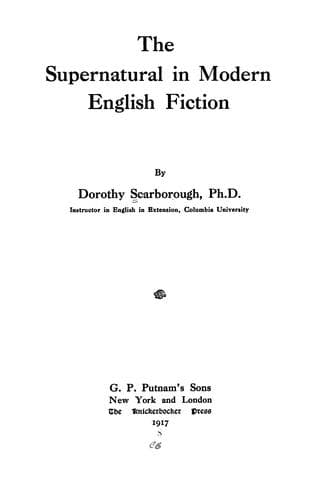
The Supernatural in Modern English FictionScarborough, Dorothy
History
The Supernatural in Modern English Fiction
Scarborough, Dorothy
English fiction -- History and criticism; Supernatural in literature
The analysis and representation of the devil as a character in
literature have covered a great range, from the bestiality of Dante's
Demon in the _Inferno_ to Milton's mighty angel in ruins, with all
sorts of variations between, from the sneering cynicism of Goethe's
Mephisto to the pinchbeck diabolism of Marie Corelli's sorrowful Satan,
and the merry humor and blasphemous satire of Mark Twain's mysterious
stranger. We note an especial influence of Goethe's Mephistopheles
in the satiric studies of the demon, an echo of his diabolic climax
when in answer to Faust's outcry over Margaret's downfall and death,
he says, "_She is not the first_!" One hears echoing through all
literature Man Friday's unanswerable question, "Why not God kill
debbil?" The uses of evil in God's eternal scheme, the soul's free
choice yet pitiful weakness, are sounded again and again. The great
diabolic figures, in their essential humanity, their intellectual
dignity, their sad introspection, their pitiless testing of the human
soul to its predestined fall, are terrible allegorical images of the
evil in man himself, or concepts of social sins, as in _Ivan, the
Fool_. The devils of the great writers, reflecting the time, the racial
characteristics, the personal natures of their creators, are deeply
symbolic. Each man creates the devil that he can understand, that
represents him, for, as Amiel says, we can comprehend nothing of which
we have not the beginnings in ourselves. As each man sees a different
Hamlet, so each one has his own devil, or _is_ his own devil. This is
illustrated by the figure in Julian Hawthorne's _Lovers in Heaven_,
where the dead man's spirit meets the devil in the after life,--who is
his own image, his dæmonic double. Some have one great fiend, while
others keep packs of little, snarling imps of darkness. A study of
comparative diabolics is illuminating and might be useful to us all.
=The Wizard and the Witch.= The demon has his earthly partners in evil
members of the firm of Devil and Company. Certain persons that have
made a pact with him are given a share in his power, and a portion of
his dark mantle falls upon them. The sorcerer and the witch are ancient
figures in literature, and like others of the supernatural kingdom,
notably the devil, they have their origin in the East, the cuneiform
writings of the Chaldeans showing belief in witchcraft. And the Witch
of Endor, summoning the spirit of Samuel to confront Saul, is a very
real figure in the Old Testament. The Greeks believed in witches, as
did the Romans. Meroe, a witch, is described in the _Metamorphoses_ of
Lucius Appuleius, from whom perhaps the witch Meroe in Peele's _Old
Wives' Tale_ gets her name and character. In classical times witches
were thought to have power to turn men into beasts, tigers, monkeys, or
asses--some persons still believe that women have that power and might
give authenticated instances.
Public-domain text, read in full here on John Shaqi.
Reviews
Reviews
No reviews yet
Be the first to share your thoughts on this work.
Elsewhere in the archive
Join the Discussion
Join the discussion
Sign in to leave a comment or review.
Sign InorCreate an account