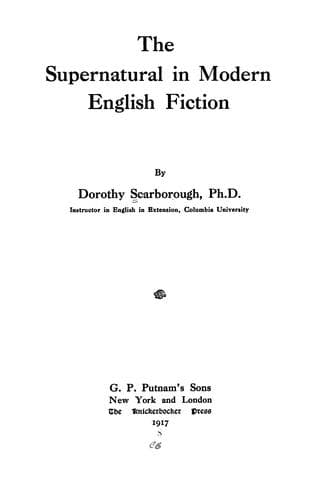
The Supernatural in Modern English FictionScarborough, Dorothy
History
The Supernatural in Modern English Fiction
Scarborough, Dorothy
English fiction -- History and criticism; Supernatural in literature
The subject of witchcraft greatly interested Hawthorne, for he
introduces it in a number of instances. _Young Goodman Brown_ shows
the aspects of the diabolic union between the devil and his earthly
companions, their unholy congregations in the forest, reports their
sardonic conversations and suggestions of evil in others, and pictures
the witches riding on broomsticks high in the heavens and working
their magic spells. The young husband sees in that convocation all
the persons whom he has most revered--his minister, his Sabbath-school
teacher, and even his young wife, so that all his after-life is
saddened by the thought of it. Witchcraft enters into _The Scarlet
Letter_, _Main Street_, and _Feathertop_, and is mentioned in other
stories.
Old Mother Sheehy in Kipling's _The Courting of Dinah Shadd_
pronounces a malediction against Private Mulvany and the girl he
loves, prophesying that he will be reduced in rank instead of being
promoted, will be a slave to drink so that his young wife will take
in washing for officers' wives instead of herself being the wife of
an officer, and that their only child will die,--every bitter word
of which comes true in after years. The old witch mother in Howard
Pyle's _The Evil Eye_ inspires her daughter to cast a spell over the
man she loves but who does not think of her, causing him to leave his
betrothed and wed the witch daughter. When understanding comes to him,
and with it loathing, the girl seeks to regain his love by following
the counsel of an old magician, who gives her an image to be burnt. But
that burning of the image kills her and looses the man from her spell.
That incident is similar to that in D'Annunzio's _Sogno d'un Tramonto
d'Autunno_ where the Dogaressa seeks to slay her rival, both probably
being based on the unforgettable employment of the theme in Rossetti's
_Sister Helen_, where the young girl causes the death of her betrayer
by melting the image.
In Gordon Bottomley's play, _Riding to Lithend_, three old women
enter, who seem to partake of the nature of the Parcæ as well as of
Shakespeare's Weird Sisters. They have bat-webbed fingers, the hound
bays uncannily at their approach, they show supernatural knowledge
of events, and they chant a wild prophecy of doom, then mysteriously
disappear. Fate marches swiftly on as they foretell.
Public-domain text, read in full here on John Shaqi.
Reviews
Reviews
No reviews yet
Be the first to share your thoughts on this work.
Elsewhere in the archive
Join the Discussion
Join the discussion
Sign in to leave a comment or review.
Sign InorCreate an account