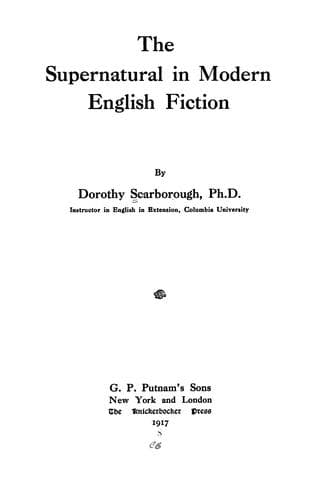
The Supernatural in Modern English FictionScarborough, Dorothy
History
The Supernatural in Modern English Fiction
Scarborough, Dorothy
English fiction -- History and criticism; Supernatural in literature
Polidori's story, like the play referred to, has for its principal
character an Englishman, Lord Ruthven, the Earl of Marsden, who is the
vampire. In each case there is a supposed death, where the dying man
asks that his body be placed where the last rays of the moon can fall
upon it. The corpse then mysteriously vanishes. In each story there is
a complication of a rash pledge of silence made by a man that discovers
the diabolical nature of the earl, who, having risen from the dead,
is ravaging society as a vampire. In each case a peculiar turn of the
story is that the masculine vampire requires for his subsistence the
blood of young women, to whom he must be married. He demands a new
victim, hence a hurried wedding is planned. In the play the ceremony
is interrupted by the bride's father, but in the novelette the plot
is finished and the girl becomes the victim of the destroyer. It is
a question which of these productions was written first, and which
imitated the other, or if they had a common source. The author of the
drama admits getting his material from a French play, but where did
Polidori get his?
Byron seems to have been fascinated with the vampire theme, for in
addition to his unsuccessful short story, he has used the theme in his
poem, _The Giaour_. Here he brings in the idea that the vampire curse
is a judgment from God for sin, and that the most terrible part of the
punishment is the being forced to prey upon those who in life were
dearest to him, which idea occurs in various stories.
"But first on earth as Vampyre sent
Thy corse shall from its tomb be rent;
Then ghastly haunt thy native place
And suck the blood of all thy race;
There from thy _daughter_, _sister_, _wife_,
At midnight drain the stream of life;
Yet loathe the banquet which perforce
Must feed thy livid, living corse.
Thy victims, ere they yet expire
Shall know the demon for their sire;
As, cursing thee, thou cursing them,
Thy flowers are withered on the stem.
But one, that for thy crime must fall,
The youngest, best-beloved of all,
Shall bless thee with a _father's_ name--
That word shall wrap thy heart in flame!
Yet must thou end the task and mark
Her cheek's last tinge, her eye's last spark,
And the last glassy glance must view
Which freezes o'er its lifeless blue;
Then with unhallowed hand shall tear
The tresses of her yellow hair,
Of which, in life, a lock when shorn
Affection's fondest pledge was worn,--
But now is borne away by thee
Memorial of thine agony!
Yet with thine own best blood shall drip
Thy gnashing teeth and haggard lip;
Then stalking to thy sullen grave
Go--and with ghouls and Afrits rave,
Till these in horror shrink away
From specter more accursed than they!"
Public-domain text, read in full here on John Shaqi.
Reviews
Reviews
No reviews yet
Be the first to share your thoughts on this work.
Elsewhere in the archive
Join the Discussion
Join the discussion
Sign in to leave a comment or review.
Sign InorCreate an account