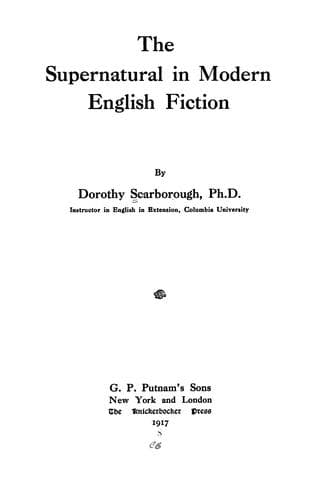
The Supernatural in Modern English FictionScarborough, Dorothy
History
The Supernatural in Modern English Fiction
Scarborough, Dorothy
English fiction -- History and criticism; Supernatural in literature
The Wandering Jew has been represented in many ways, with stress
placed on various aspects of his life and character. He has been
depicted psychologically, as a suffering human being, mythologically to
illustrate the growth and change in life, religiously to preach certain
tenets and beliefs, and symbolically to show forth the soul of man. He
appears symbolically as the creature accursed of God, driven forever
in the face of doom. Shelley and others show him as vainly attempting
suicide, but living on, anguished yet deathless, in the face of every
effort to take his own life as in the teeth of torture from others. He
stands at once for the undying power of God's plan, and, as in Robert
Buchanan's version, for the typified failure of Christ's mission. He is
used to prove that Christ's second coming is near, and to prove also
that He will never come. To the Christian he stands for the evidence
of Christ's power of divinity, while to the Jew he is a symbol of that
unhappy race that wanders ever, with no home in any land.
Besides those mentioned, other English and American writers who have
made use of the legend are Kipling; Bram Stoker, who discusses him
in his assembly of Famous Impostors; M. D. Conway, who gives various
versions of the story; David Hoffman, Henry Seton Merriman, S.
Baring-Gould, W. H. Ainsworth, and others.
A legend closely associated with this and yet separate, is that of
a woman who bore the curse of eternal wandering. One version brings
in Herodias as the doomed woman, while the character of Kundry in
_Parsifal_ represents another feminine wanderer. William Sharp, in his
_Gypsy Christ_, gives the story differently still, saying that it is
not correctly told in _Parsifal_. As Sharp tells it, it is a piece of
tragic symbolism. Kundry, a gypsy woman of evil life, mocks Christ on
Golgotha and demands of Him a sign, to whom He says, "To thee and thine
I bequeath the signs of my Passion to be a shame and horror among thy
people forevermore!" Upon her hands and feet appear the stigmata of His
wounds, never to fade away, and to be borne by her descendants in every
third generation. Various ones of her descendants are crucified, and
wherever the wanderers go on earth they bear the marks of horror. The
curse would be lifted from them only when a Gypsy Christ should be born
of a virgin; but then the Children of the Wind should be dispersed and
vanish from among men. In the last chapter Naomi prophesies that she is
to give birth to the Gypsy Christ.
Public-domain text, read in full here on John Shaqi.
Reviews
Reviews
No reviews yet
Be the first to share your thoughts on this work.
Elsewhere in the archive
Join the Discussion
Join the discussion
Sign in to leave a comment or review.
Sign InorCreate an account