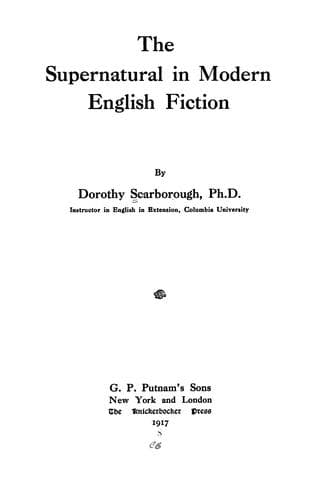
The Supernatural in Modern English FictionScarborough, Dorothy
History
The Supernatural in Modern English Fiction
Scarborough, Dorothy
English fiction -- History and criticism; Supernatural in literature
Bulwer-Lytton's _The Haunters and the Haunted_ tells the story of a
mysterious being who passes through untold years with a strange power
over life and the personality of others. He appears, no man knows
whence nor why, and disappears as strangely, while about his whole
career is a shroud of mystery. Thackeray, in his _Notch on the Axe_,
burlesques this and similar stories in playful satire, yet seems to
enjoy his theme. It is not wholly a burlesque, we may suppose. He
adds a touch of realism to his humorous description by the fact that,
throughout his hero's long-continued life, or series of lives--one
doesn't know which--he retains always his German-Jewish accent. Andrew
Lang describes[165] the person who may have been the original of these
stories in real life. Horace Walpole has mentioned him in his letters
and he seems to have a teasing mystery about his life and career that
makes him much talked-of.
[165] In _St. Germain the Deathless_.
Edwin Lester Arnold[166] tells a story of continued life with an
Oriental setting and mystery. Edward Bellamy's _Looking Backward_,
by the introduction of a magic sleep makes a man live far beyond the
natural span and be able to see into the distant future, while the
youth in Mark Twain's _A Connecticut Yankee at King Arthur's Court_ has
a magic length of life, living a dual existence, in Arthurian England
and in present-day America. H. G. Wells[167] uses something of the same
idea, in that he makes his hero live a very long time in a few hours,
compressing time into minute tabules, as it were, as he does in another
story of the magic accelerator that makes a man live fast and furiously
with tenfold powers at crucial moments. The story of Peter Rugg, the
Missing Man, is that of another immortal wanderer, whose story is told
in _Myths and Legends of Our Land_, and utilized by Alfred Austin. He
goes out into a storm, saying, "I will see home to-night or I will
never see it!" He flies forever pursued by the storm, never resting,
and never seeing his home. This is symbolic of the haunted soul pursued
by its own destiny.
[166] In _The Strange Adventures of Phra the Phoenician_.
[167] In his _Time Machine_.
The theme of the elixir of life is one of the old motifs of
supernaturalism retained in modern fiction. The conventional alchemist
has given place to a more up-to-date investigator in the chemical
laboratory, yet the same thrill of interest is imparted by the thought
of a magic potion prepared by man that shall endow him with earthly
immortality. The theme has changed less in its treatment and symbolism
than most of the supernatural elements in fiction, for though we see
the added elements of modern satire and symbolism, its essential
aspects remain the same.
Public-domain text, read in full here on John Shaqi.
Reviews
Reviews
No reviews yet
Be the first to share your thoughts on this work.
Elsewhere in the archive
Join the Discussion
Join the discussion
Sign in to leave a comment or review.
Sign InorCreate an account