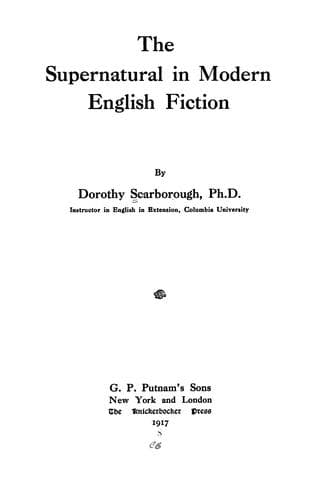
The Supernatural in Modern English FictionScarborough, Dorothy
History
The Supernatural in Modern English Fiction
Scarborough, Dorothy
English fiction -- History and criticism; Supernatural in literature
_The Mystery of Joseph Laquedem_, by A. T. Quiller-Couch, is a
striking story of dual reincarnation. A young Jew in England and a
half-witted girl, a farmer's daughter, recognize in each other and
in themselves, the personalities of a young Jew led to the lions
for becoming a Christian, and a Roman princess who loved him. They
recall their successive lives wherein they have known and loved each
other, to be separated by cruel destiny each time, but at last they
die a tragic death together. The character of the man here is given
additional interest for us in that he is said to be a reincarnation of
Cartapholus, Pilate's porter, who struck Jesus, bidding Him go faster,
and who is immortalized as the Wandering Jew. Here he lives successive
lives rather than a continuous existence. Somewhat similar to this
is another combination of hypnotism and metempsychosis in _The Witch
of Prague_, by F. Marion Crawford, where Uorna makes Israel Kafka go
through the physical and psychical tortures of Simon Abeles, a young
Jew killed by his people for becoming a Christian. By hypnotism the
young man is made to pass through the experiences of a dead youth of
whom he has never heard, and to die his death anew.
There is a close relation between dreams and metempsychosis, as is seen
in certain stories. Kipling's charming prose idyll, _The Brushwood
Boy_, may be called a piece of dream-metempsychosis, for the youth and
girl when they first meet in real life recognize in each other the
companions of their childhood and adolescent dream-life, and complete
their dual memories. They have dreamed the same dreams even to minute
details of conversation, and familiar names. Du Maurier combines the
two motives very skillfully in his novels, for it is in successive
dreams that the Martian reveals herself to Barty Joscelyn telling him
of her life on another planet, and inspiring him to write--or writing
for him--books of genius, before she takes up earthly life in one
of his children. She tells him that she will come to him no more in
dreams, but that she will live in the child that is to be born. And in
dual dreams Peter Ibbetson and the Duchess of Towers live over again
their childhood life together, are able to find at will their golden
yesterdays, and know in happy reality the joys of the past, while the
present keeps them cruelly apart. They are able to call back to shadowy
life their common ancestors, to see and hear the joys, the work, the
griefs they knew so long ago. They plumb their sub-consciousness, dream
over again their sub-dreams, until they at last not only see these
long-dead men and women, but _become_ them.
We could each be Gatienne for a space (though not both of us
together) and when we resumed our own personality again we carried
back with it a portion of hers, never to be lost again--strange
phenomenon if the reader will but think of it, and constituting the
germ of a comparative personal immortality on earth.
Public-domain text, read in full here on John Shaqi.
Reviews
Reviews
No reviews yet
Be the first to share your thoughts on this work.
Elsewhere in the archive
Join the Discussion
Join the discussion
Sign in to leave a comment or review.
Sign InorCreate an account