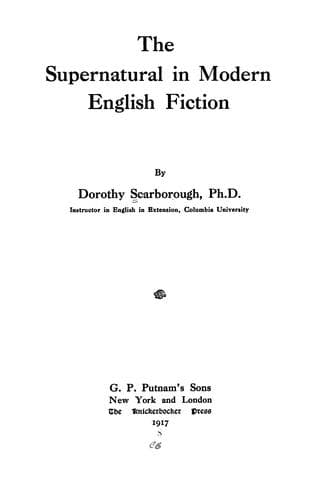
The Supernatural in Modern English FictionScarborough, Dorothy
History
The Supernatural in Modern English Fiction
Scarborough, Dorothy
English fiction -- History and criticism; Supernatural in literature
The revolters in the French novel take up Parisian life, while
Stephens's angelic trio join an itinerant tinker and his daughter
who are journeying aimlessly about, accompanied by a cart and a
sad-eyed philosopher, an ass. They engage in activities and joys not
conventionally archangelic, such as smoking corn-cob pipes, eating cold
potatoes, and, when necessary, stealing the potatoes. The contrasts
between heavenly ideas and Irish tramp life are inimitable. At last
when the three, having decided to go back to heaven, don their wings
and crowns and say good-bye, the cherub turns back for one more word
of farewell with Mary. Seeing her tears over his going, he tears his
shining wings to shreds and casts them from him, electing to stay on
earth with the tinker's cart, for the sake of love. It is really quite
a demi-god-like thing to do.
Unlike France's book, which is a blasting satire on religion, these
two English novels are amusing, with a certain measure of satire, yet
with a whimsicality that does not antagonize. France's angels remain on
earth and become more corrupt than men, and Wells's wonderful visitor
is banished from the village as an undesirable alien. Stephens's
archangel and seraph go back to heaven after their vacation, while
the cherub turns his back on immortal glory rather than break a
woman's heart. In all three of these books we notice the same leveling
tendency shown in characterization of the angels that we have observed
heretofore in the case of ghosts and devils, werewolves, and witches.
The angels are human, with charming personality and a piquant sense
of humor, whose attempts to understand mortal conventions reveal the
essential absurdity of earthly ideas in many instances. The three
taken together constitute an interesting case of literary parallelism
and it would be gratifying to discover whether France was influenced
by Wells and Stephens, or Stephens by Wells and France,--but in any
event Wells can prove a clear alibi as to imitation, since his novel
appeared a number of years before the others. The possible inspiration
for all of these in Byron's _Heaven and Earth_ suggests an interesting
investigation. A more recent story, _The Ticket-of-Leave Angel_,
brings an angel down to a New York apartment, where he has peculiar
experiences and illustrates a new type of angelic psychology. The
tendency to satirize immortality has crept even into poetry, for in a
recent volume by Rupert Brooke there are several satiric studies. One,
entitled _On Certain Proceedings of the Psychical Research Society_,
ridicules the idea that spirits would return to earth to deliver the
trivial messages attributed to them, and another, _Heaven_, is a
vitriolic thrust at the hope of a better life after death, sneering at
it with unpleasant imagery.
Public-domain text, read in full here on John Shaqi.
Reviews
Reviews
No reviews yet
Be the first to share your thoughts on this work.
Elsewhere in the archive
Join the Discussion
Join the discussion
Sign in to leave a comment or review.
Sign InorCreate an account