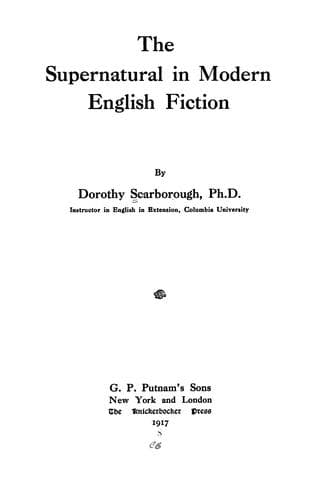
The Supernatural in Modern English FictionScarborough, Dorothy
History
The Supernatural in Modern English Fiction
Scarborough, Dorothy
English fiction -- History and criticism; Supernatural in literature
The volumes of fairy stories are by no means all for juvenile
consumption, since the modern adult dearly loves the type himself.
Many, or most, of the stories of fairies told frankly for children are
adaptations or variants of continental folk-legends. The more literary
side of fairy-literature has come from the Celtic lore, for the Dim
People are dearest of all supernatural beings to the Celtic soul. The
Irish, more innately poetic than most races, cling more fondly to the
beings of beauty and gather round them delicate, undying stories. W. B.
Yeats, Lady Gregory, Lady Wilde, Oscar Wilde, John Singe, and Fiona
McLeod have given in poetry and lyric prose the Celtic fairy-lore, and
have made us know the same wild, sweet thrill that the peasants feel.
The poetic thought of the primitive races peoples everything in nature,
every bird and blossom and tree, with its own fairy personality.
Thackeray has written a fairy pantomime for great and small children,
as he says, in which the adventures of Prince Giglio and Prince Bulbo
are recounted. Eugene Field has a charming story of the _Fairies of
Pesth_, and Charles Kingsley's _Water Babies_ enriched the imagination
of most of us in youthful or adult years with its charming nonsense
of beings possible and impossible. J. M. Barrie in _Peter Pan_ won
the doubtful world over to a confessed faith in the fairy-folk, for
did we not see the marvels before our eyes? In _The Little White
Bird_ Barrie tells us how fairies came to be,--that they have their
origin in the first laugh of the first baby that broke into a million
bits and went skipping about, each one a fairy. He shows us the wee
folk in Kensington Gardens, where by the ignorant they are mistaken
for flowers, but children and those with the poet heart can see the
flashing faces and green garments of the fairies among the pansy beds.
W. B. Yeats is a favorite with the fairies, for they have given him the
dower of magic vision, to glimpse the unseen things, to hear the faint,
musical voices of fairy pipes and song. He tells us many stories of the
Dim People, in his tales and dramas. _The Land of Heart's Desire_,
the story of the struggle between the divine and mortal forces and the
powers of the Sidhe to claim the soul of the young wife and of the
triumph of the fairies, by which the girl's body falls lifeless by the
hearth while her spirit speeds away to live forever in the land "where
nobody gets old or sorry or poor," has a poignant pathos, a wild,
dreamy beauty that touches the heart. Yeats tells of the Imperishable
Rose of Beauty, of fantastic doings of the fairy-folk who steal mortals
away, especially new-born babies or new-wed brides, of evil fairies who
slay men in malice, and of the dances by moonlit hillside when mortals
are asleep.
Public-domain text, read in full here on John Shaqi.
Reviews
Reviews
No reviews yet
Be the first to share your thoughts on this work.
Elsewhere in the archive
Join the Discussion
Join the discussion
Sign in to leave a comment or review.
Sign InorCreate an account