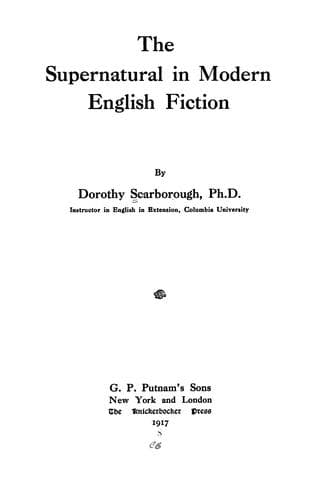
The Supernatural in Modern English FictionScarborough, Dorothy
History
The Supernatural in Modern English Fiction
Scarborough, Dorothy
English fiction -- History and criticism; Supernatural in literature
_The Portent_, by George MacDonald, is a curious study of hypnotic
influence, of a woman who is her true self only when in a
somnambulistic state. A supernatural connection of soul exists between
her and a youth born on the same day, and it is only through his
hypnotic aid that she gains her personality and sanity. James L. Ford
plays with the subject by having a group of persons in an evening party
submit themselves to be hypnotized in turn, each telling a true story
of his life while in that condition. W. D. Howells combines mesmerism
with spiritualism in his novel,[203] where the séances are really the
result of hypnotism rather than supernatural revelation as the medium
thinks. H. G. Wells has used this theme, as almost every other form of
scientific ghostliness, though without marked success. The prize story
of hypnotism, however, still remains Du Maurier's _Trilby_, for no
mesmerist in this fiction has been able to outdo Svengali.
[203] _The Undiscovered Country._
* * * * *
Uncanny chemistry forms the ingredient for many a modern story. The
alchemist was the favored feature of the older supernatural fiction of
science, and his efforts to discover the philosopher's stone and to
brew the magic elixir have furnished plots for divers stories. He does
not often waste his time in these vain endeavors in recent stories,
though his efforts have not altogether ceased, as we have seen in a
previous chapter. A. Conan Doyle[204] is among the last to treat the
theme, and makes the scientist find his efforts worse than useless,
for the research student finds that his discovery of the art of making
gold is disturbing the nice balance of nature and bringing injury to
those he meant to help, so he destroys his secret formula and dies.
_The Elixir of Youth_ illustrates the transference of power from the
sorcerer to the scientist, for the magician that gives the stranger a
potion to restore his youth tells him that he is not a sorcerer, not a
diabolic agent, but a scientist learning to utilize the forces that are
at the command of any intelligence.
[204] In _The Doings of Raffles Haw_.
Public-domain text, read in full here on John Shaqi.
Reviews
Reviews
No reviews yet
Be the first to share your thoughts on this work.
Elsewhere in the archive
Join the Discussion
Join the discussion
Sign in to leave a comment or review.
Sign InorCreate an account