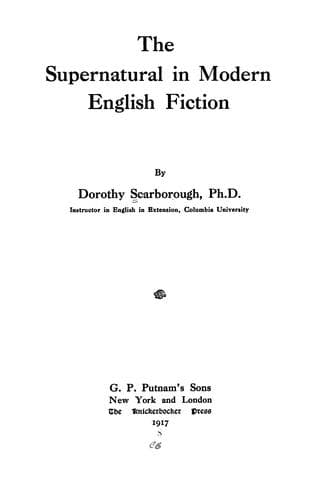
The Supernatural in Modern English FictionScarborough, Dorothy
History
The Supernatural in Modern English Fiction
Scarborough, Dorothy
English fiction -- History and criticism; Supernatural in literature
* * * * *
Botany furnishes its ghostly plots in fiction as well as other branches
of science, for we have plant vampires and witches and devils. Trees
and flowers are highly psychic and run a gamut of emotions. Hawthorne
shows us supernatural plants in several of his novels and stories,
such as the mysterious plant growing from a secret grave, which has a
strange poisonous power, or the flowers from Gaffer Dolliver's garden
that shine like jewels and lend a glow to the living face near them,
when worn on a woman's breast. In _Rappaccini's Daughter_ the garden
is full of flowers of subtle poison, so insidious that their venom
has entered into the life of the young girl, rendering her a living
menace to those around her. She is the victim of her father's dæmonic
experiments in the effects of poison on the human body, and her kiss
means death. Algernon Blackwood[205] tells of the uncanny power of
motion and emotion possessed by the trees, where the forest exercises a
magnetic force upon human beings sympathetic to them, going out after
men and luring them to their fate. He describes the cedar as friendly
to man and attempting but in vain to protect him from the creeping
malignant power of the forest.
[205] In _The Man whom the Trees Loved_.
Fu-Manchu, Sax Rohmer's Chinese horror, performs various experiments
in botany to further his dreadful ends. He develops a species of
poisonous fungi till they become giant in size and acquire certain
powers through being kept in the darkness. When a light is turned on
them, the fungi explode, turning loose, on the men he would murder,
fumes that drive them mad. From the ceiling above are released ripe
spores of the giant Empusa, for the air in the second cellar, being
surcharged with oxygen, makes them germinate instantly. They fall like
powdered snow upon the victims and the horrible fungi grow magically,
spreading over the writhing bodies of the mad-men and wrapping them
in ghostly shrouds. In _The Flower of Silence_ he describes a strange
orchid that has the uncanny habit of stinging or biting when it is
broken or roughly handled, sending forth a poison that first makes a
man deaf then kills him. Fu-Manchu introduces this flower into the
sleeping-rooms of those he wishes to put out of the way, and sends them
into eternal silence. _The Flowering of the Strange Orchid_, by H. G.
Wells, is the story of a murderous plant, a vampire that kills men in
the jungle, and in a greenhouse in England sends out its tentacles
that grip the botanist, drinking his blood and seeking to slay him.
This orchid has the power to project its vampiric attacks when it
is a shriveled bulb or in the flower. This reminds us of Algernon
Blackwood's story of the vampire soil, which after its psychic orgy
burst into loathsome luxuriant bloom where before it had been barren.
Public-domain text, read in full here on John Shaqi.
Reviews
Reviews
No reviews yet
Be the first to share your thoughts on this work.
Elsewhere in the archive
Join the Discussion
Join the discussion
Sign in to leave a comment or review.
Sign InorCreate an account