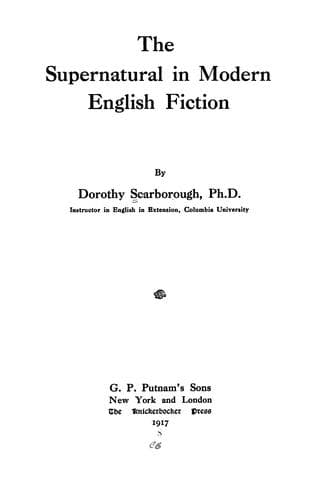
The Supernatural in Modern English FictionScarborough, Dorothy
History
The Supernatural in Modern English Fiction
Scarborough, Dorothy
English fiction -- History and criticism; Supernatural in literature
Not only are new materials introduced in the later fiction of the
uncanny but new types are stressed. In addition to the weird stories
told with direct aim and art--ghosts for ghosts' sake--there are tales
where the supernatural element is of secondary importance, being
used to teach some truth or ridicule some fallacy. The symbolistic,
humorous, and satiric methods abound in modern occult fiction and
when well done have a double effect, that of primary supernatural
impressiveness, and, in addition, of the subtler purposes behind the
stories. Moralized legends, spiritual allegories such as Hawthorne
wrote with consummate art, have continued to the present and form
a contrast to the crude machinery of Gothic horrors. The delicacy
of suggestion, the power of hinted ghostliness, though manifest in
Shakespeare, are really modern achievements, for no one save him
attained to them in earlier art. Mystic poetic fiction, spiritual
symbolism appears in much of the modern unearthly writing. In certain
cases it is interesting to note the change of old mythological stories
into moral allegory. The plays and the stories of Lord Dunsany are
peculiarly symbolic and have the force of antique mythology made
instant and real. Yet they have a distinctive touch all their own.
For instance, the story of the king who goes over the world seeking
his lost yesterday, his dear past, who is told by the weird keeper
of the bygone years that he cannot have it back, no not one golden
second, has a delicate pathos of poetry. When the mournful king has
gone back to his palace, a hoar harper comes who plays for him, and
lo! to the strings of the harp have clung the golden seconds of his
happiest hours, so that he lives them over again while the music
lasts. _The Book of the Serpent_ tells symbolic stories that are poems
in prose, fantastic fables. The Creator is making experiments with
dust-heaps, while the Serpent, the Turtle, and the Grasshopper look
on, ask questions, and offer comments. The Serpent trails all through
the dust-heap meant as stuff for artists, and the Maker drops a tear
in that whereof He means to make mothers. He experiments with monkeys
trying to learn how best to make man, and after man is complete, He
makes woman. The stories of Oscar Wilde have, some of them, a beauty
like that of some antique illuminated missal, with its jeweled words,
its mystic figures. Wilde's ornate style, prose that trembles on the
verge of poetry, full of passion and color and light, makes one think
of his own words in _The Nightingale and the Rose_, where the poet's
song was "builded of music by moonlight and stained with his own
heart's blood."
Public-domain text, read in full here on John Shaqi.
Reviews
Reviews
No reviews yet
Be the first to share your thoughts on this work.
Elsewhere in the archive
Join the Discussion
Join the discussion
Sign in to leave a comment or review.
Sign InorCreate an account