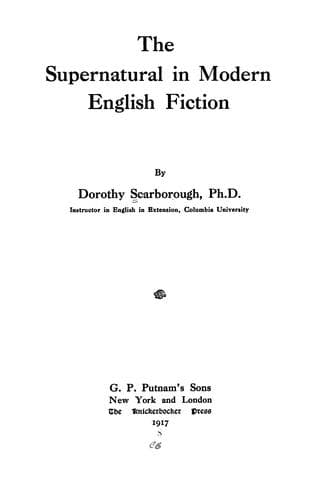
The Supernatural in Modern English FictionScarborough, Dorothy
History
The Supernatural in Modern English Fiction
Scarborough, Dorothy
English fiction -- History and criticism; Supernatural in literature
Gothic fiction had much to say of melancholy birds that circled
portentously over ancient castles filled with gloom and ghosts, but
they were generic and not individual specimens. The fowl was always
spoken of as "a bird of prey," "a night bird," "a bat," "an owl," or
by some such vague term. Natural history has become more generally
known since those times and writers of to-day introduce their ominous
birds with more definiteness and appropriateness. The repulsive bat
that clings to the window ledge in Bram Stoker's novel is a vampire,
a symbol of the whole horrible situation, as the kite that soars
menacingly overhead in another of his novels is individualized and
becomes a definite thing of terror. Poe's raven is vastly more a bird
of evil than any specimen in the Gothic aviary. Robert W. Chambers
brings in a cormorant several times as a portent of ghostly disaster,
particularly foreboding when it turns toward the land. "On the dark
glistening cliffs, silhouetted against the glare of the sea, sat a
cormorant, black, motionless, its horrible head raised toward heaven."
There is in recent fiction no bird more dreadful in import than the
belled buzzard that Irvin Cobb makes the leading figure in his story by
that name. This is an excellent example of the use of the natural to
produce terror and awe, for the murderer sees in the bird a minister of
fate, and the faint tinkle of its bell as it soars over the marsh where
the body lies buried paralyzes him with horror. At last he can bear no
more, and hearing it, as he thinks, close at hand, he shrieks out his
confession,--only to find this time that it is not the belled buzzard
at all that he hears, but only an old cowbell that a little negro child
has picked up in the barnyard!
Robert W. Chambers in his early stories contrives to give varying
supernatural effects by descriptions of shadows as symbolic of life
and character. He speaks of shadows of spirits or of persons fated to
disaster as white; again his supernatural shadows may be gray--gray
is a favored shade for ghostly effect whether for witches or for
phantoms--and sometimes they are perfectly black, to indicate differing
conditions of destiny. Quiller-Couch has a strange little allegory,
_The Magic Shadow_, and other writers have used similar methods to
produce uncanny effects.
Public-domain text, read in full here on John Shaqi.
Reviews
Reviews
No reviews yet
Be the first to share your thoughts on this work.
Elsewhere in the archive
Join the Discussion
Join the discussion
Sign in to leave a comment or review.
Sign InorCreate an account