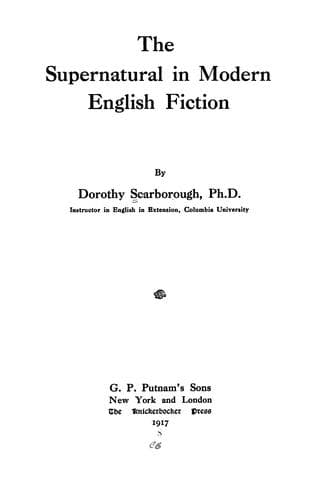
The Supernatural in Modern English FictionScarborough, Dorothy
History
The Supernatural in Modern English Fiction
Scarborough, Dorothy
English fiction -- History and criticism; Supernatural in literature
The effectiveness of modern ghostly stories is aided by the
suggestiveness of the unearthly given by the use of "sensitives,"
animals or persons that are peculiarly alert to the occult impressions.
We see in many stories that children perceive the supernatural
presences more quickly than adults, as in Mrs. Oliphant's story of the
ghost returning to right a wrong, trying strenuously to make herself
known to the grown person and realized only by a little child. In
Belasco's play the little boy is the first and for a long time the only
one to sense the return of Peter Grimm. In Maeterlinck's _The Blind_,
the baby in arms is aware of the unearthly presences better than the
men and women. Sometimes the sensitive is a blind person, as the old
grandfather in another of Maeterlinck's short plays, who is conscious
of the approaching Death before any of the others, or blind Anna in
D'Annunzio's drama, _The Dead City_.
Animals are quick to perceive supernatural manifestations. Cats
in fiction are shown as being at ease in the presence of ghosts
perhaps because of their uncanny alliance with witches, while dogs
and horses go wild with fear. This is noticed in many stories, as in
Bulwer-Lytton's story of the haunted house where the dog dies of
terror in the face of the ghostly phenomena. The Psychic Doctor told of
in Blackwood's uncanny stories, who goes to a house possessed by evil
spirits, takes with him a cat and a dog which by their difference of
action reveal to him the presence of the spirits long before they are
visualized for him.
In general, there is more power of suggestion in the later ghostly
stories than in the earlier. The art is more subtle, the technique more
skillfully studied, more artfully accidental.
Public-domain text, read in full here on John Shaqi.
Reviews
Reviews
No reviews yet
Be the first to share your thoughts on this work.
Elsewhere in the archive
Join the Discussion
Join the discussion
Sign in to leave a comment or review.
Sign InorCreate an account