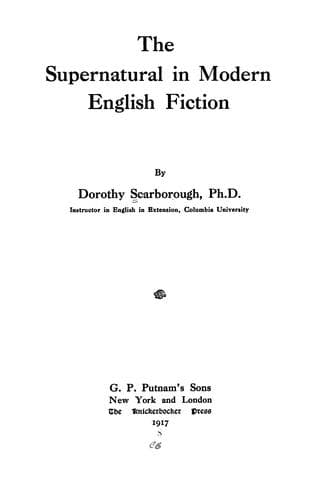
The Supernatural in Modern English FictionScarborough, Dorothy
History
The Supernatural in Modern English Fiction
Scarborough, Dorothy
English fiction -- History and criticism; Supernatural in literature
The different nightmare sensations, acute and vivid as they are, can be
analyzed to find parallelisms between them and the ghostly plots. For
example, take the sensation, common in nightmares, of feeling yourself
falling from immeasurable height. The same thrill of suspense is
communicated by the climax in Lewis's and Mrs. Dacre's Gothic novels,
where the devil takes guilty mortals to the mountain top and hurls
them down, down. The horrible potentialities of shadows suggested
frequently in dreams is illustrated by Mary Wilkins Freeman's story
where the accusing spirit comes back as a haunting shadow on the wall,
rather than as an ordinary ghost, tormenting the living brother till
_his_ shadow also appears, a portent of his death.[70] The awful grip
of causeless horror, of nameless fear which assails one so often in
nightmares is represented in _The Red Room_,[71] where black Fear, the
Power of Darkness, haunts the room rather than any personal spirit. It
is disembodied horror itself. Wilkie Collins illustrates the presaging
vision of approaching disaster in _The Dream Woman_. The nightmare
horror of supernaturalism is nowhere better shown than in Maupassant's
_La Horla_ where the sleeper wakes with a sense of leaden weight upon
his breast, and knows that night after night some dreadful presence
is shut in with him, invisible yet crushing the life out of him and
driving him mad.
[70] _The Shadows on the Wall._
[71] By H. G. Wells.
The nightmare motifs are present to a remarkable degree in
Bulwer-Lytton's _The Haunted and the Haunters, or the House and
the Brain_. There we have the gigantism of the menacing Thing, the
supernatural power given to inanimate objects, the ghostly chill, the
darkness, and the intolerable oppression of a nameless evil thing
beside one. Vampirism might easily be an outcome of dreams, since
based on a physical sensation of pricking at the throat, combined with
debility caused by weakness, which could be attributed to loss of blood
from the ravages of vampires. F. Marion Crawford's story, _For the
Blood Is the Life_, is more closely related to dreams than most of the
type, though probably Bram Stoker's _Dracula_ is the most horrible.
Public-domain text, read in full here on John Shaqi.
Reviews
Reviews
No reviews yet
Be the first to share your thoughts on this work.
Elsewhere in the archive
Join the Discussion
Join the discussion
Sign in to leave a comment or review.
Sign InorCreate an account