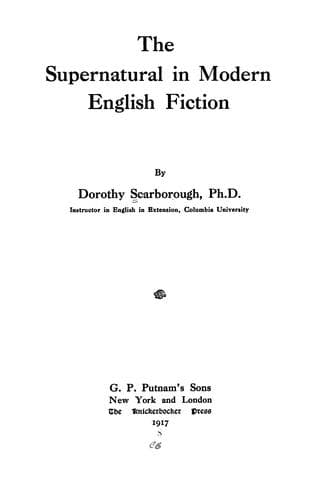
The Supernatural in Modern English FictionScarborough, Dorothy
History
The Supernatural in Modern English Fiction
Scarborough, Dorothy
English fiction -- History and criticism; Supernatural in literature
The curious side of supernaturalism as related to dreams is illustrated
by _The Dream Gown of the Japanese Ambassador_,[72] and the more
beautiful by Simeon Solomon's _Vision of Love Revealed in Sleep_. Mary
Wilkins Freeman has a remarkable short story, _The Hall Bedroom_,
which is one of the best illustrations of the use of dream imagery
and impressions. Here the effects are alluring and beautiful, with
the horror kept in the background, but perhaps the more effective
because of the artistic restraint. Odors, sights, sounds, feelings,
are all raised to an intensity of sensuous, slumbrous enjoyment,
all subliminated above the mortal. The description of the river in
the picture, on which the young man floats away to dreamy death,
similar to the Japanese story referred to by Hearn, helps to give the
impression of infinity that comes only in dreams. Algernon Blackwood in
numerous stories not only uses the elements of dreams and nightmares
but explicitly calls attention to the fact. Dream supernaturalism is
employed in Barry Pain's stories, in Arthur Machen's volume,[73] and in
many others. Freud's theory of dreams as the invariable result of past
experiences or unconscious desires has not been stressed in fiction,
though doubtless it will have its inning presently. A. Conan Doyle's
_The Secret of Goresthorpe Grange_ is an amusing story of the relation
of definite wishes and dreams of the ghostly.
[72] By Brander Matthews.
[73] _The Hill of Dreams._
These are some of the sources from which the later writers of occultism
have drawn their plots. They represent a distinct advance over the
Gothic and earlier supernaturalism in materials, for the modern story
has gained the new elements without loss of the old. The ghostly
fiction of to-day has access to the animistic or classical or medieval
themes, yet has the unlimited province of present thought to furnish
additional inspiration. There never was a time when thinking along
general lines was more spontaneously reflected in fiction than now,
and supernatural literature claims all regions for its own. Like every
other phase of man's thought, ghostly fiction shows the increasing
complexity of form and matter, the wealth of added material and
abounding richness of style, the fine subtleties that only modernity
can give.
CHAPTER III
MODERN GHOSTS
Public-domain text, read in full here on John Shaqi.
Reviews
Reviews
No reviews yet
Be the first to share your thoughts on this work.
Elsewhere in the archive
Join the Discussion
Join the discussion
Sign in to leave a comment or review.
Sign InorCreate an account