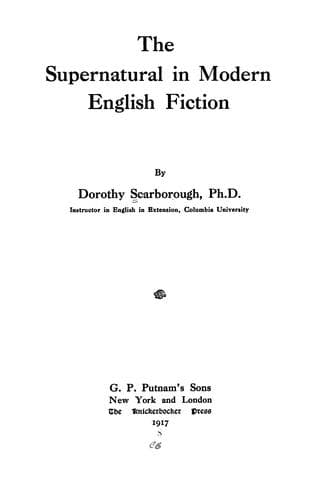
The Supernatural in Modern English FictionScarborough, Dorothy
History
The Supernatural in Modern English Fiction
Scarborough, Dorothy
English fiction -- History and criticism; Supernatural in literature
In Crawford's _A Doll's Ghost_, that peculiar example of preternatural
fiction, not a children's story as one might think, nor yet humorous,
the mechanical voice of the doll and the click of its tiny pattering
feet occur as strange sounds. Lord Strafford[101] walks with a firm,
audible tread on his way to appall the king, and in Blackwood's _Empty
House_ the ghosts move with sounds of heavy, rushing feet, followed
by a noise of scuffling and smothered screams as the ancient murder
is re-enacted, then the thud of a body thrown down the stairs,--after
which is a terrible silence. The awful effect of a sudden silence
after supernatural sounds is nowhere shown more tensely than in _The
Monkey's Paw_,[102] that story of superlative power of suggestion. When
the ghostly visitant knocks loudly at the outer door, we feel the same
thrill of chilling awe as in the knocking at the gate in Macbeth, and
more, for the two who hear are sure that this is a presence come back
from the dead. Then when the last magic wish has been breathed, utter
silence comes, a silence more dreadful in its import than the clamor
has been.
[101] In _John Inglesant_.
[102] By W. W. Jacobs.
New sounds are introduced in modern ghostly tales, such as the peculiar
hissing that is a manifestation of the presence of the ancient
spirit[103] followed by the crackling and crashing of the enchanted
flames. In Blackwood's _Keeping His Promise_ the heavy, stertorous
breathing of the invisible Thing is heard, and the creaking of the
bed weighted down by the body. Mary Wilkins Freeman brings in ghostly
crying in a story, while Blackwood speaks of his Wendigo as having "a
sort of windy, crying voice, as of something lonely and untamed, wild
and of abominable power." Kipling introduces novel and touching sounds
in his stories of ghostly children. The child-wraiths are gay, yet
sometimes near to tears. He speaks of "the utterly happy chuckle of a
child absorbed in some light mischief," "sudden, squeaking giggles of
childhood," "the rustle of a frock and the patter of feet in the room
beyond," "joyous chuckles of evasion," and so forth. These essentially
childlike and lifelike sounds are deeply pathetic as coming from the
ghosts of little ones that hover, homesick, near the earth they dread
to leave. The little ghost boy in Richard Middleton's story,[104]
manifests himself, invisibly, through the little prancing steps, the
rustling of the leaves through which he runs, and the heart-breaking
imitations of an automobile. Later ghostly fiction introduces few of
the clankings of chains and lugubrious groans that made the Gothic
romance mournful, and the modern specters are less wailful than the
earlier, but more articulate in their expression. There are definite
ghostly sounds that recur in various stories, such as the death-rap
above the bed of the dying, the oft-mentioned mocking laughter in
empty places, the cry of the banshee which is the presage of death not
Public-domain text, read in full here on John Shaqi.
Reviews
Reviews
No reviews yet
Be the first to share your thoughts on this work.
Elsewhere in the archive
Join the Discussion
Join the discussion
Sign in to leave a comment or review.
Sign InorCreate an account