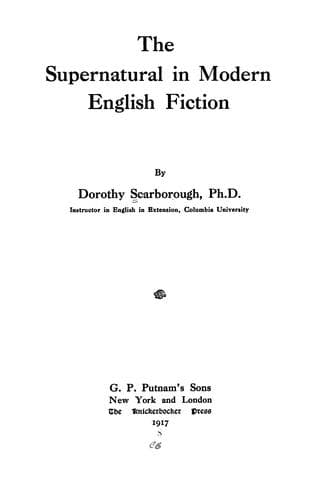
The Supernatural in Modern English FictionScarborough, Dorothy
History
The Supernatural in Modern English Fiction
Scarborough, Dorothy
English fiction -- History and criticism; Supernatural in literature
"Nuffin," say de li'l black boy whut he name am Mose, "but I jes'
feel kinder oneasy 'bout de ghosts whut ain't!"
Jes' lack white folks. Jes' lack white folks.
CHAPTER IV
The Devil and His Allies
"Ghosts are few but devils are plenty," said Cotton Mather, but his
saying would need to be inverted to fit present-day English fiction.
Now we have ghosts in abundance but devils are scarce. In fact, they
bid fair to become extinct in our romances, at least in the form that
is easily recognizable. Satan will probably soon be in solution,
identified merely as a state of mind. He has been so Burbanked of
late, with his dæmonic characteristics removed and humanities added
that, save for sporadic reversion to type, the old familiar demon is
almost a vanished form. The modern mind seems to cling with a new
fondness to the ghost but has turned the cold shoulder to the devil,
perhaps because many modernists believe more in the human and less
in the supernatural--and after all, ghosts are human and devils are
not. The demon has disported himself in various forms in literature,
from the scarlet fiend of monkish legend, the nimble imp and titanic
nature-devil of folk-lore to Milton's epic, majestic Satan, and
Goethe's mocking Mephistopheles, passing into allegoric, symbolic, and
satiric figures in later fiction. He has been an impressive character
in the drama, the epic, the novel, in poetry, and the short story. We
have seen him as a loathly, brutish demon in Dante, as a superman,
as an intellectual satirist, and as a human being appealing to our
sympathy. He has gradually lost his epic qualities and become human.
He is not present in literature now to the extent to which he was known
in the past, is not so impressive a figure as heretofore, and at times
when he does appear his personality is so ambiguously set forth that it
requires close literary analysis to prove his presence.
In this chapter the devil will be discussed with reference to his
appearances on earth, while in a later division he will be seen in
his own home. It would be hard to say with certainty when and where
the devil originated, yet he undoubtedly belongs to one of our first
families and is said to have been born theologically in Persia about
the year 900 B.C. He has appeared under various aliases, as Ahriman of
the Zoroastrian system, Pluto in classical mythology, Satan, Beelzebub,
Prince of Darkness, and by many other titles. In his _Address to the
De'il_ Burns invokes him thus:
"Oh, Thou! whatever title suit thee,--
Auld Hornie, Satan, Nick or Cloutie!"
He has manifested himself in fiction under diverse names, as Demon,
Lucifer, Satan, Mephistopheles, Prince Lucio, The Man in Black, and so
forth, but whatever the name he answers to, he is known in every land
and has with astonishing adaptability made himself at home in every
literature.
Public-domain text, read in full here on John Shaqi.
Reviews
Reviews
No reviews yet
Be the first to share your thoughts on this work.
Elsewhere in the archive
Join the Discussion
Join the discussion
Sign in to leave a comment or review.
Sign InorCreate an account