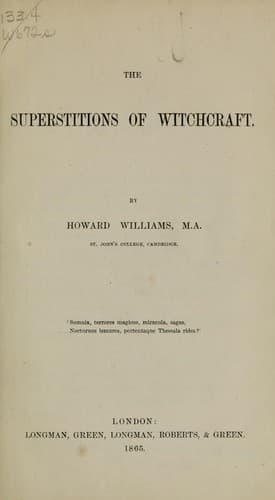
[140] _Table Talk or Discourses_ of John Selden. Although it
must be excepted to the lawyer's summary mode of dealing
with an imaginary offence, we prefer to give that eminent
patriot at least the benefit of the doubt, as to his belief
in witchcraft.
If men of more liberal sentiments were thus enslaved to old
prejudices, it is not surprising that the Church, not leading but
following, should firmly maintain them. Fortunately for the
witches, without the motives actuating in different ways
Catholics and Calvinists, and placed midway between both parties,
the reformed English Church was not so much interested in
identifying her crimes with sorcerers as in maintaining the less
tremendous formulae of Divine right, Apostolical succession, and
similar pretensions. Yet if they did not so furiously engage
themselves in actual witch-prosecutions, Anglican divines have
not been slow in expressly or impliedly affirming the reality of
diabolical interposition. Nor can the most favourable criticism
exonerate them from the reproach at least of having witnessed
without protestation the barbarous cruelties practised in the
name of heaven; and the eminent names of Bishop Jewell, the great
apologist of the English Church, and of the author of the
'Ecclesiastical Polity,' among others less eminent, may be
claimed by the advocates of witchcraft as respectable authorities
in the Established Church. The 'judicious' Hooker affirms that
the evil spirits are dispersed, some in the air, some on the
earth, some in the waters, some among the minerals, in dens and
caves that are under the earth, labouring to obstruct and, if
possible, to destroy the works of God. They were the _dii
inferi_ [the old persuasion] of the heathen worshipped in
oracles, in idols, &c.[141] The privilege of 'casting out devils'
was much cherished and long retained in the Established Church.
[141] Quoted in Howitt's _History of the Supernatural_. The
author has collected a mass of evidence 'demonstrating an
universal faith,' a curious collection of various
superstition. He is indignant at the colder faith of the
Anglican Church of later times.
Public-domain text, read in full here on John Shaqi.
Reviews
Reviews
No reviews yet
Be the first to share your thoughts on this work.
Elsewhere in the archive
Join the Discussion
Join the discussion
Sign in to leave a comment or review.
Sign InorCreate an account