The dangerously increasing class of informers who, like the
'delatores' of the early Roman Empire, made a lucrative
profession by their baseness, and spared not even reluctant or
recusant magistrates themselves, more than anything else, was the
cause of the termination of the trials. If they would preserve
their own lives, or at least their reputations, the authorities
and judges found it was necessary at once to check the progress
of the infection. About one hundred and fifty witches or wizards
were still under arrest (two hundred more being about to be
arrested), when Governor Phipps having been recalled by the Home
Government, was induced by a feeling of interest or justice to
release the prisoners, to the wonder and horror of the people.
From this period a reaction commenced. Those who four years
before originated the trials suddenly became objects of hatred or
contempt. Even the clergy, who had taken a leading part in them,
became unpopular. In spite of the strenuous attempts of Dr.
Cotton Mather and his disciples to revive the agitation, the tide
of public opinion or feeling had set the other way, and people
began to acknowledge the insufficiency of the evidence and the
possible innocence of the condemned. Public fasts and prayers
were decreed throughout the colony. Judges and juries emulated
one another in admitting a misgiving 'that we were sadly deluded
and mistaken.' Dr. Mather was less fickle and less repentant. In
one of his treatises on the subject, recounting some of the
signs and proofs of the actual crime, he declares: 'Nor are these
the tenth part of the prodigies that fell out among the
inhabitants of New England. _Fleshy_ people may burlesque these
things: but when hundreds of the most solemn people, in a country
where they have as much mother-wit certainly as the rest of
mankind, know them to be true, nothing but the froward spirit of
Sadduceeism can question them. I have not yet (he confidently
asserts) mentioned so much as one thing that will not be
justified, if it be required, by the oaths of more considerate
persons than any that can ridicule these odd phenomena.'[160]
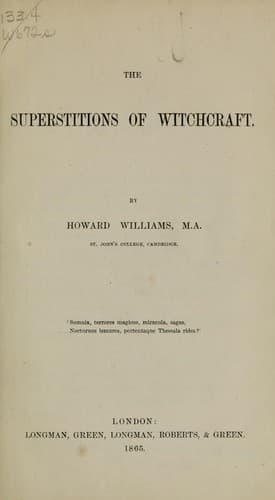
[160] _Narratives of Sorcery and Magic_, chap. xxxi. The
faith of the Fellow of Harvard College, we may be inclined
to suppose, was quickened in proportion to his doubts. To do
him justice, he admitted that _some_ of the circumstances
alleged might be exaggerated or even imaginary.
Public-domain text, read in full here on John Shaqi.
Reviews
Reviews
No reviews yet
Be the first to share your thoughts on this work.
Elsewhere in the archive
Join the Discussion
Join the discussion
Sign in to leave a comment or review.
Sign InorCreate an account