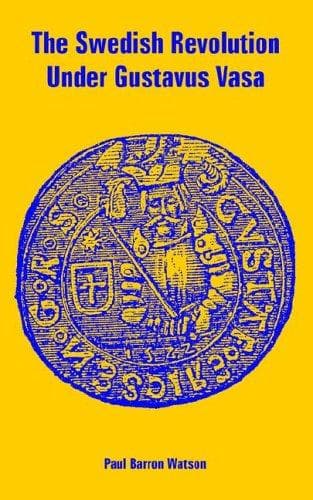
The Swedish Revolution Under Gustavus VasaWatson, Paul Barron
History
The Swedish Revolution Under Gustavus Vasa
Watson, Paul Barron
Gustav I Vasa, King of Sweden, 1496-1560; Sweden -- History -- Gustav I Vasa, 1523-1560
While Gustavus was thus dickering with the Dalesmen, a far more weighty
matter kept him continually on an anxious seat at home. This was the
Reformation of the Romish Church. It has been already noted that the
Swedish Reformation was a political revolt, and at its outset had but
little connection with theological dispute. The conflagration that had
raged in Germany since 1519 produced no immediate effect in Sweden, and
it was not till the spring of 1523 that the Swedish prelates felt real
dread of Martin Luther. The father of the Swedish Reformation was Olaus
Petri, a blacksmith's son, of Örebro. From his earliest years this
champion of Luther had been educated by a pious father for the Romish
Church. His childhood had been passed amid the religious influence of a
monastery in his native town. There, with his younger brother
Laurentius, he had shared the daily routine of a monk. When a mere boy
his father, little knowing the temptation to which his son would be
exposed, had placed him in the University of Wittenberg, where he sat
for some years at the feet of Luther. On his return to Sweden in 1519,
he was appointed to give instructions in the Bible to the youth of
Strengnäs. Though only twenty-two, he already showed such promise that
within a year he was chosen deacon of Strengnäs, and placed at the head
of the school belonging to the Chapter. The opportunity thus given him
was great. The bishopric being vacant, the charge of things in Strengnäs
fell upon Laurentius Andreæ, at the time archdeacon. Andreæ, though
fifteen years his senior, was of a kindred spirit, and by a contemporary
is described as a willing pupil of the young reformer. There can be no
question that even at this period Petri was regarded as a man of
strength. A portrait of him painted when still a youth shows in a marked
degree the traits by which he was distinguished later. The face is full
and round, with large, warm eyes twinkling with merriment, and a high,
clear forehead, from which is thrown back a heavy mass of waving hair.
The mouth is firm as adamant, and the sharp-cut lips and chin are
eloquent of strength. Altogether, it is the picture of just the man that
Petri afterward became,--a brilliant orator, daring, good-natured, and
gifted with a generous supply of common-sense. Precisely how much Petri
owed to Martin Luther we cannot know. It is not, however, likely that at
first his teaching in Strengnäs differed materially from that inculcated
by the Romish Church. At any rate, he taught four years before any
serious complaint was made. The first to charge him with heresy was
Bishop Brask. On the 7th of May, 1523, that much-enduring prelate wrote
to a member of the Upsala Chapter that a certain person in Strengnäs had
inflamed the people by preaching heresies; "and God knows," he added,
"we are grieved enough to learn that he is not silenced." What these
heresies preached by Petri were, appears from a polemic hurled at the
young reformer by Brask's deacon.
Public-domain text, read in full here on John Shaqi.
Reviews
Reviews
No reviews yet
Be the first to share your thoughts on this work.
Elsewhere in the archive
Join the Discussion
Join the discussion
Sign in to leave a comment or review.
Sign InorCreate an account